Contemporary Challenges: Fall-2026
Homework 5 (SOLUTION): Due Week 5 Friday (10/30)
- Tea kettle

Consider the electric kettle shown in the picture. There is 1 kg of water in the kettle (4 cups of water). This electric kettle transfers energy to the water by heating. The rate of energy transfer is 1000 J/s. The specific heat capacity of water is 4.2 J/(g.K). Calculate the rate that the water temperature rises. Give your answer in units of kelvin/s.
Note: This is an exercise in proportional reasoning. You should not need to look up any formulas.
Sense-making: Put it in context---At this rate, how long would it take to heat up a kettle for making tea? Does this seem like a realistic number?We want to know long it takes a tea kettle to boil. When there are 4 cups of water (about 1000 g of water) the heat capacity of this amount of water is 4200 J/K. The inverse of this quantity is \begin{align} \text{temperature change per energy} = \left(\frac{1}{4200}\frac{\text{K}}{\text{J}}\right). \end{align} We are adding heat at a rate of 1000 J/s, therefore the rate of temperature change is \begin{align} \text{rate of \(T\) change} &= \left(1000\frac{\text{J}}{\text{s}}\right) \left(\frac{1}{4200}\frac{\text{K}}{\text{J}}\right) \\ &= 0.24 \frac{\text{K}}{\text{s}} \\ &\approx 14 \frac{\text{K}}{\text{minute}}. \end{align}
To heat the water to boiling, it will need to rise from 20\(^\circ\)C to 100\(^\circ\)C, which is a temperature change of 80 K, since a Kelvin has the same size as a \(^\circ\)C. So the amount of time required to boil water will be \begin{align} \text{time to boil} &= 80\text{ K} \div \left(14 \frac{\text{K}}{\text{minute}}\right) \\ &\approx 5.5 \text{ minutes} \end{align} I usually forget about my hot water by the time it's boiling, so we can conclude that my attention span is less than five or six minutes, which sounds about right.
- Entropy Basics
- (T3B.5) Objects A and B have different temperatures and initial entropies of 22 J/K and 47 J/K. We bring the objects into thermal contact and allow them to come to equilibrium (the objects are isolated from everything else). What is the most quantitative statement that we can make about the combined system's entropy after the two objects come to equilibrium?
After the two objects with different temperatures have exchanged energy the system can be described using the following equation. \begin{align} S_{\text{A}} + S_{\text{B}} > 69 \text{ J/K} \end{align}
- (T3B.8) Suppose that we increase an object's internal energy 10 J by heating the object. The temperature of the object remains roughly constant at 20 C. By how much does the object's entropy increase?
When the temperature of the object is approximately constant, then \begin{align} \Delta S &= \frac{Q}{T}\\ &= \frac{10 \text{ J}}{293 \text{ K}} = 0.03 \text{ J/K} \end{align}
- (T3B.5) Objects A and B have different temperatures and initial entropies of 22 J/K and 47 J/K. We bring the objects into thermal contact and allow them to come to equilibrium (the objects are isolated from everything else). What is the most quantitative statement that we can make about the combined system's entropy after the two objects come to equilibrium?
- Heat Pump
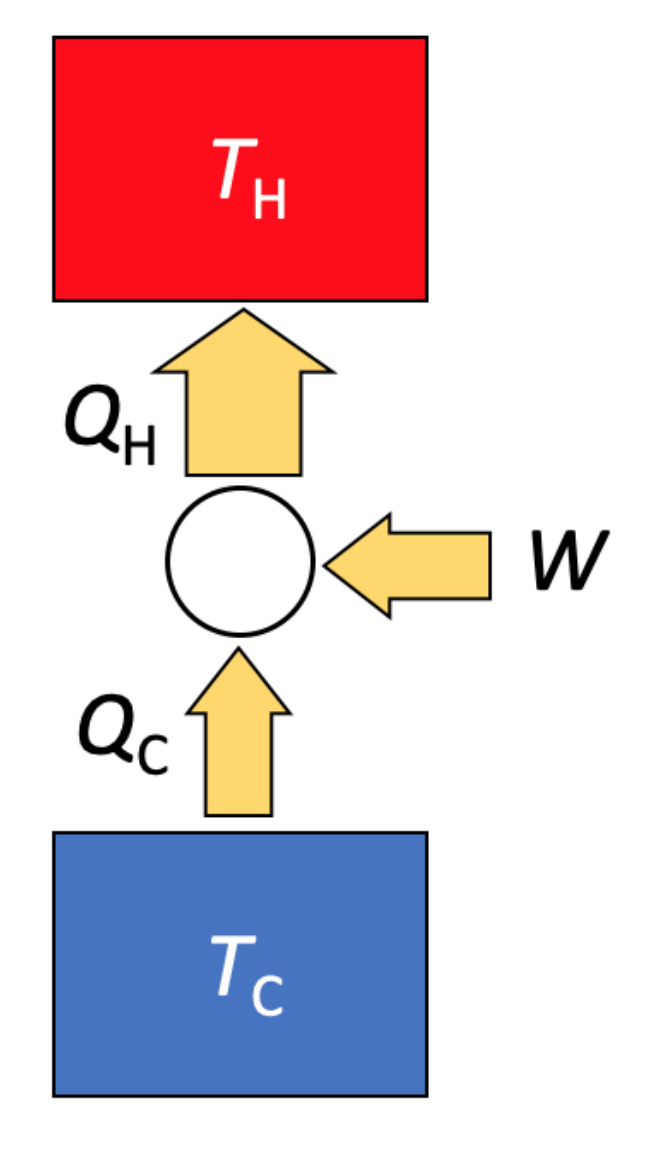
The diagram shows a machine (the white circle) that moves energy from a cold reservoir to a hot reservoir. We will consider whether a machine like this is useful for heating a family home in the winter when the temperature inside the family home is \(T_\text{H}\), and the temperature outside the house is \(T_\text{C}\). To quantify the performance of this machine, I'm interested in the ratio \(Q_\text{H}/W\), where \(Q_{\text{H}}\) is the heat energy entering the house, and \(W\) is the net energy input in the form of work. (\(W\) is the energy I need to buy from the electricity company to run an electric motor). Starting from the 1\(^{\text{st}}\) and 2\(^\text{nd}\) laws of thermodynamics, find the maximum possible value of \(Q_\text{H}/W\). This maximum value of \(Q_\text{H}/W\) will depend solely on the ratio of temperatures \(T_\text{H}\) and \(T_\text{C}\).
We are tring to maximize the heat flowing into the high temperature reservoir for a given amount of work input. By the first law of thermodynamics we know that
\[Q_{\text{C}}+W = Q_{\text{H}}\]
If I fix W, then increasing \(Q_{\text{C}}\) will increase \(Q_\text{H}\).
By the second law of thermodynamics we know \begin{align} -\frac{Q_{\text{C}}}{T_{\text{C}}} + \frac{Q_{\text{H}}}{T_{\text{H}}} \geq 0 \end{align}
If we use the beggest \(Q_{\text{C}}\) then \begin{align} \frac{Q_{\text{C}}}{T_{\text{C}}} = \frac{Q_{\text{H}}}{T_{\text{H}}}\\ \rightarrow \frac{Q_{\text{C}}}{Q_{\text{H}}} = \frac{T_{\text{C}}}{T_{\text{H}}} \end{align}
We can combine the two equations to get the efficiency: \begin{align*} \epsilon = \frac{Q_\text{H}}{W} &= \frac{Q_\text{H}}{Q_\text{H}-Q_\text{C}}\\[6pt] \frac{1}{\epsilon} &= \frac{Q_\text{H}-Q_\text{C}}{Q_\text{H}} \\[6pt] &= 1- \frac{Q_\text{C}}{Q_\text{H}} \\[6pt] &= 1- \frac{T_\text{C}}{T_\text{H}} \\[6pt] &= \frac{T_{\text{H}}-T_{\text{C}}}{T_\text{H}} \\[6pt] \epsilon &= \frac{T_\text{H}}{T_{\text{H}}-T_{\text{C}}} \end{align*}
To understand this answer, I can consider a few special cases. If \(T_\text{H} = T_{\text{C}}\), then no work is needed. If \(T_{\text{C}}\rightarrow 0\), then \(Q_\text{H} = W\). All the heat must come from work.
I'm also noticing that the difference in temperature between the reservoirs is going to be smaller than the temperature of the hot reservoirs, so I'm expecting efficiencies that are bigger than 1.
Sensemaking: Choose realistic values of \(T_\text{H}\) and \(T_\text{C}\) to describe a family home on a snowy day. Based on your temperature estimates, what is the maximum possible value of \(Q_\text{H}/W\)?
For a snowy day, let \(T_{\text{C}} = 270\) K and \(T_\text{H} = 290\) K.
Substituting that into my equation, I get \(Q_\text{H}/W = 290/20 \approx 15\).
That sounds great! How well do real heat pumps perform? See wikipedia: “Heat Pump”, subsection “performance considerations.” It says that \(Q_\text{H}/W \approx 3.2-4.5\) for a unit you can install at your house.
- Thermal energy in the earth's atmosphere
Thermal energy is stored in all materials on Earth, including the air, water and rocks. The air is composed mostly of diatomic molecules such as N\(_2\) and O\(_2\).
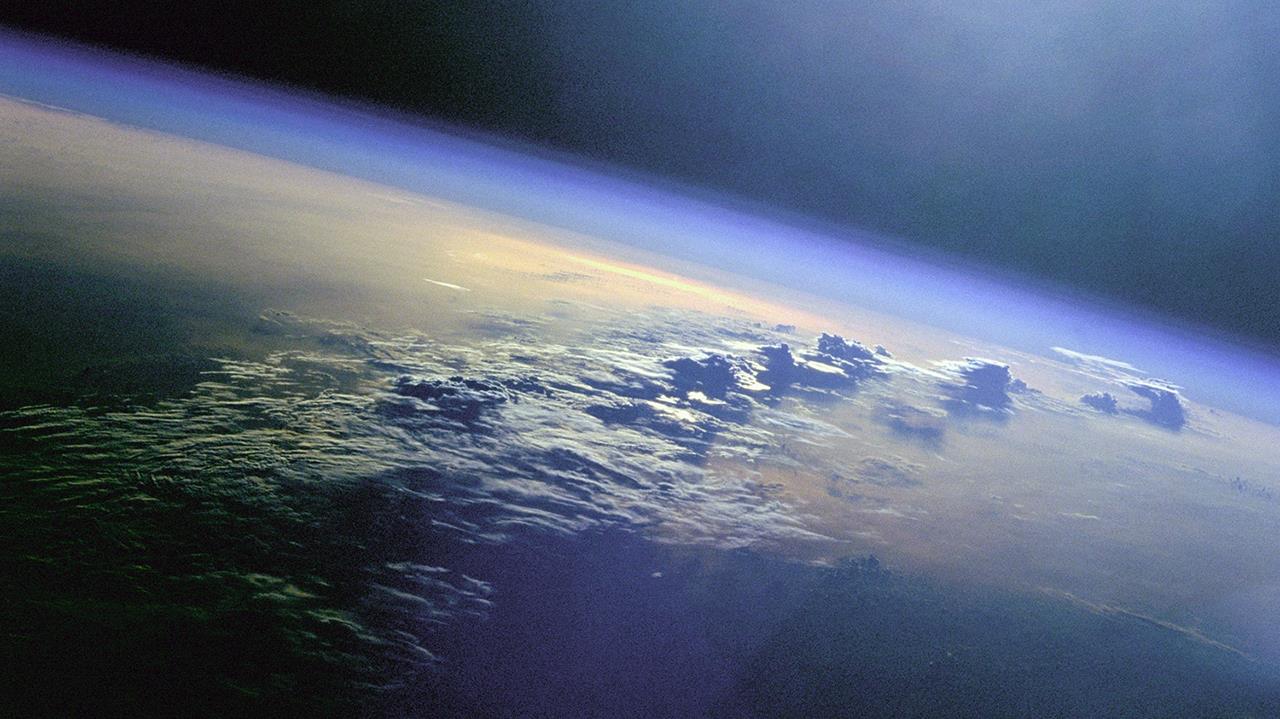
Use Google to look up the mass of the earth's atmosphere. Now, exercise some skepticism and make sure that Goggle's answer is consistent with other facts about the earth: Air pressure at sea level is about 100 kPa and the radius of the earth is about 6400 km. The air pressure at sea level (force per unit area) is caused by the downward force of gravity acting on the atmosphere directly above a unit area. The thickness of the atmosphere is much much less than the radius of the earth. Give your argument supporting or refuting the internet's value for the mass of the earth's atmosphere.
Google says the mass of the Earth's atmosphere is \(5\times10^{18}\) kg. I want to check this. First, consider a column of air.
Every square meter of earth's surface has 10,000 kg of air directly above it. Radius of the Earth is \(\approx\) 6400 km. \begin{align} m_\text{atm} &= \left(4 \pi r_\text{earth}^2\right)(m_\text{sqr})\\ &= 4 \pi (6.4\times10^6 \text{ m})^2 (10^4 \text{ kg/m}^2) \\ &= 5\times 10^{18} \text{ kg} \end{align}
We know that between 1955 and 2010, the temperature of the top 2000 meters of the ocean rose by about 0.05 C. Given this fact, assess the validity of the following statement:
“If the same amount of heat that has gone into the top 2000 meters of the ocean between 1955-2010 had gone into the lower 10 km of the atmosphere, then the atmosphere would have warmed by about 20\(^\circ\)C (36\(^\circ\)F).”
Is this statement reasonable, or ridiculous? Show your calculations that support your conclusion. Your starting assumptions will include the specific heat capacity of air and water at constant pressure, and a reasonable guess regarding the fraction of the earth's surface that is covered with ocean.
I need to calculate the mass of water in top 2000 m of ocean. \begin{align} \text{Surface area of earth} &= 4 \pi R_\text{earth}^2\\ &=4 \pi (6.4\times10^{6})^2\\ &= 5.14\times10^{14} \text{ m}^2\\ \\ \text{Volume of water} &= \left(\frac{2}{3}\right)(5\times10^{14})(2\times10^3) \text{ m}^3\\ &\text{The 2/3 is because 2/3 of the planet is ocean}\\ &= 7\times10^{17}\text{ m}^3\\ \\ \text{Mass of water} &= (10^3 \text{ kg/m}^3)(7\times10^{17} \text{ m}^3) = 7\times10^{20} \text{ kg} \end{align} Now we can find the heat required to raise the ocean temperature by 0.05\(^\circ\) C. \begin{align} Q &= m c_\text{p,water} \Delta T \\ &= [7\times10^{20} \text{ kg}][4.2 \text{ kJ}\cdot\text{kg}^{-1}\cdot\text{K}^{-1}][5\times10^{-2} \text{ K}]\\ &= 10^{20}\text{ kJ} \end{align} Heat required to raise air temperature by 20\(^\circ\)C. \begin{align} Q &= m c_\text{p,air} \Delta T \\ &= (5\times10^{18} \text{ kg})(1 \text{ kJ}\cdot\text{kg}^{-1}\cdot\text{K}^{-1})(20 \text{ K})\\ &= 10^{20}\text{ kJ} \end{align}
Note that I've used the heat capacity of air at constant pressure (\(c_\text{p,air} \approx 1 \text{ kJ}\cdot\text{kg}^{-1}\cdot\text{K}^{-1}\)), which is greater than the heat capacity of air at constant volume (\(c_\text{v,air} \approx 0.7 \text{ kJ}\cdot\text{kg}^{-1}\cdot\text{K}^{-1}\)). The reason for this difference is the following. If we heat a gas while keeping the pressure of the gas constant, then some heat energy must be turned into work - expanding the volume of the gas. Thus, less heat energy goes into raising the internal energy of the gas.
When answering this question, \(c_\text{p,air}\) is the correct choice. I won't dock points if you used \(c_\text{v,air}\). For example, if you estimated the heat capacity of air using the equipartition theorem, you should have found a reasonable value for \(c_\text{v,air}\).
The statement appears to be true, the same amount of heat is required to either raise the ocean temp by 0.05\(^\circ\)C or to raise the air temp by 20\(^\circ\)C.