Contemporary Challenges: Fall-2026
Homework 6 (SOLUTION): Due Week 6 Friday (11/6)
- Multiplicity of an ideal gas
- (T3M.7) The multiplicity of an ideal monatomic gas with \(N\) atoms, internal energy \(U\), and volume \(V\) turns out to be roughly
\begin{align}
\Omega (U, V, N) = CV^NU^{\left(\frac{3 N}{2}\right)}
\end{align}
where \(C\) is a constant that depends on \(N\) alone. Use this expression, together with the fundamental definition of temperature, and they fundamental definition of entropy, to find \(U\) as a function of \(N\) and \(T\) for an ideal gas.
Based on \(\Omega\) for an ideal gas, find the relationship between \(U\) and \(T\). From class we know \(S = k_\text{B} \ln \Omega\). Additionally, if we hold the volume of the gas constant, \(dS/dU = 1/T\) (this comes from our multiplicity-based definition of temperature). Therefore, \begin{align} \frac{1}{T} &= k_\text{B} \frac{d}{d U} \ln \left(C V^N U^{3N/2}\right)\\ &= k_\text{B} \frac{d}{d U} \left[\ln C + N \ln V + \frac{3 N}{2} \ln U\right]\\ &= k_\text{B} \frac{3 N}{2}\frac{1}{U} \end{align} So, rearranging the equation, \(U = \frac{3}{2} N k_\text{B} T\).
- (From the GRE PhysicsSubject GR0177, given in 2001)
Note 1: The irreversibility of this process tells you that entropy must go (up or down?).
Note 2: The gas constant, \(R\), is equal to \(N_{\text{Avogadro}} \cdot k_B\). Since the process is irreversible, the total change in entropy (for the whole system) must be positive. This eliminates option (D) and (E) in the multiple choice question.

I cannot describe this process as a simple “flow of heat between objects”, so I cannot use the relationship \(\Delta S = Q/T\).
The volume doubles while \(N\) (the number of gas molecules) and \(U\) stay constant (there is no change in the internal energy of the gas). I'll put these quantitative statements into the expression for total entropy of a monatomic ideal gas. \[S_\text{initial} = k_\text{B} \ln\left(C V^N U^{3N/2}\right) \quad \quad \quad S_\text{final} = k_\text{B} \ln\left(C (2V)^N U^{3N/2}\right)\] \begin{align} \frac{\Delta S}{k_\text{B}} &= \frac{S_\text{final}}{k_\text{B}} - \frac{S_\text{initial}}{k_\text{B}} \\ &= \ln C + N \ln (2V) + \frac{3N}{2} \ln U - \ln C - N \ln V - \frac{3 N}{2} \ln U\\ \Delta S &= k_\text{B} N \left(\ln(2V) - \ln V\right)\\ &= k_\text{B} N \ln 2 \end{align}
From here, notice that N/n (number of atoms over number of mols) is the same as Avogadro's number. This is option (B) in the GRE question.
- (T3M.7) The multiplicity of an ideal monatomic gas with \(N\) atoms, internal energy \(U\), and volume \(V\) turns out to be roughly
\begin{align}
\Omega (U, V, N) = CV^NU^{\left(\frac{3 N}{2}\right)}
\end{align}
where \(C\) is a constant that depends on \(N\) alone. Use this expression, together with the fundamental definition of temperature, and they fundamental definition of entropy, to find \(U\) as a function of \(N\) and \(T\) for an ideal gas.
- Helium heat capacity
In class, we assumed that all monatomic gases have 3 degrees of freedom (\(f = 3\)). In this question, we explore the possibility that a monatomic gas might have additional degrees of freedom due to the electrons orbiting the nucleus, or the rotation of the nucleus. To answer this question, you will need to use the equipartition theorem and understand how quantized energy levels affect the application of the equipartition theorem.
(a) An atom of helium can store energy by bumping its electron from its lowest orbital energy level to a higher orbital energy level. Moving an electron from the lowest state to the first excited state would store an energy of 24.6 eV (24.6 electron-volts). Give a quantitative explanation (i.e. by comparing quantities) that shows we can ignore this energy storage mode when calculating the heat capacity of helium gas at ordinary temperatures.
(b) The helium-4 nucleus can be modelled as a solid spherical object with mass \(m\), radius \(r\), and moment of inertia \(I=(2/5)mr^2\). If the nucleus starts to rotate, it would have rotational kinetic energy \(K_{\text{rotation}}=L^2/(2I)\), where \(L\) is the angular momentum. Usually the helium-4 nucleus has \(L = 0\), however, it can be excited to a non-zero angular momentum state with \(L \approx \hbar\), or \(2\hbar\), or \(3\hbar\), etc. (\(L\) is quantized). Give a quantitative explanation that shows we can ignore this energy storage mode when calculating the heat capacity of helium gas at ordinary temperatures.
(a) At \(T=293\) K, \(k_\text{B}T \approx 0.025\) eV. This gives a sense of the order of magnitude of energy that a Helium atom takes on when there are temperature changes near room temperature.
An electron energy excitation, on the other hand, requires 24.6 eV. A Helium atom receiving 24.6 eV is very unlikely to get that energy from temperature changes in the surrounding environment when \(T=293\) K, because that is 1000 times higher than \(k_BT\).
(b) \(\hbar\) is the amount that the quantized angular momentum \(L\) can be raised by in a single jump, or excitation. The corresponding energy change would be: \begin{align} \Delta K_{\text{rotation}} &= \frac{(L+\hbar)^2}{2I} - \frac{L^2}{2I} \\ &= \frac{2L\hbar + \hbar^2}{2I} \end{align}
Usually, \(L=0\). Other values of \(L\) would results in higher energy changes above. For this smallest excitation, we can also use \(I\) to write it as:
\[\Delta K_{\text{rotation}} = \frac{5\hbar^2}{4mr^2}\]
Then, we can use \(\hbar = 1.05 \cdot 10^{-34} \text{ J}\cdot\text{s}\) (a constant), \(r = 1.7 \cdot 10^{-15} \text{ m}\) (we've calculated this before), and \(m = 4 \text{ g}\cdot\text{mol}^{-1} / (6 \cdot 10^{23} \text{ mol}^{-1}) = 6.7 \cdot 10^{-24} \text{ g} = 6.7 \cdot 10^{-27} \text{ kg}\).
Plugging all this in, we get:
\[\Delta K_{\text{rotation}} = \frac{5\hbar^2}{4mr^2} \approx 8 \cdot 10^{-13} \text{ J} \cdot \frac{1 \text{ MeV}}{1.6 \cdot 10^{-13} \text{ J}} = 5 \text{ MeV}\]
This is about 200 million times higher than \(k_BT\). The same argument from part (a) applies here.
- Water and air heat capacity
In the last homework, you looked up the specific heat capacity of water and air (\(c_{\text{p,water}}\) = 4.2 J/(g.K) and \(c_{\text{p,air}}\) = 1.0 J/(g.K)) to analyze changes in the earth's climate. In this problem, you'll estimate \(c_{p\text{,water}}\) and \(c_{p\text{,air}}\) from first principles. Note: You'll use the equipartition theorem which is a coarse-grained alternative to using the full machinary of statistical mechanics, so, the answers might be off by a few %.
- For liquid water at room temperature, treat every oxygen atom and hydrogen atom as a point mass held in place by a 3-dimensional network of springs (like an Einstein solid). These “springs” arise from intra-molecular bonds (bonds within an H\(_2\)O molecule) and inter-molecular forces (the forces between neighboring H\(_2\)O molecules). Assume 1 gram of water and calculate the total number of degrees of freedom. Then find the total internal energy as a function of temperature, and the specific heat capacity at constant volume. Compare with measured value of \(c_{\text{p,water}}\). Note: Liquid water doesn't expand/contract very much when heated, so \(c_{\text{p,water}} \approx c_{\text{v,water}}\).
We are using a similar setup as the model for an Einstein solid again, but now we can store energy in the springs as well. Note: This is different from how we count DoFs in an ideal gas, because we are working with liquid water now.
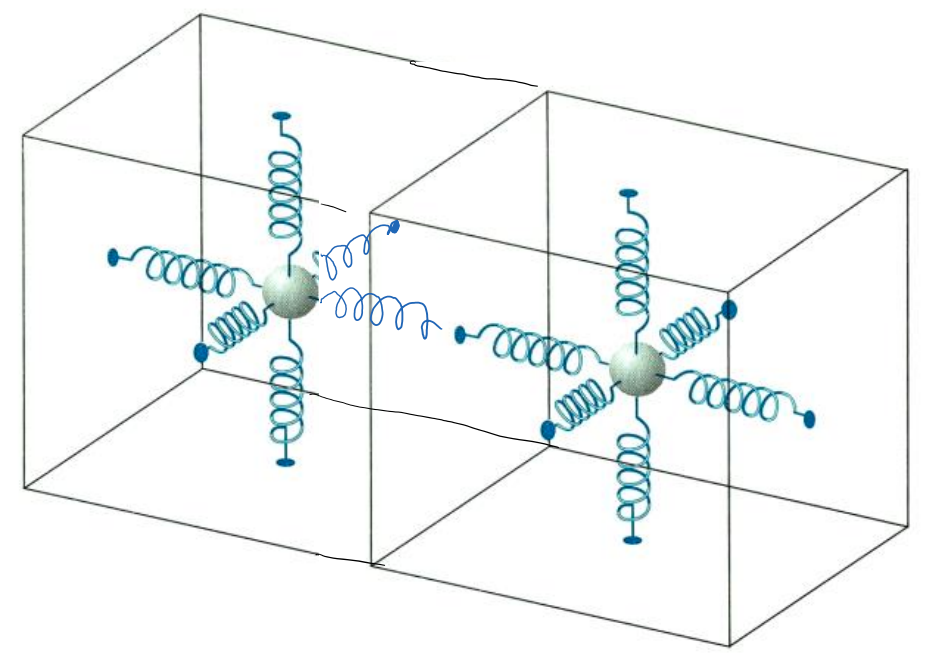
This figure shows two atoms situated like an Einstein solid model -- a single water molecule would be three atoms in a row!
In this model of liquid water, each atom has 6 degrees of freedom. Three DoF are \(v_x, v_y,\) and \(v_z\) that determine kinetic energy of the atom. Three additional DoF are \(x, y,\) and \(z\) positions of the atom that determine the how much elastic potential energy is stored in the adjacent springs.
Since there are three atoms in a water molecule, each with 6 DoFs, then we have a total of 18 DoFs for liquid water.
Another way of saying this is to write out the energy using the equipartition theorem: \begin{align} U &= \frac{6k_{\text{B}}T}{2}(N_{\text{hydrogen}}+N_{\text{oxygen}})\\ &= \frac{18k_{\text{B}}T}{2}N_{\text{water}}\\ \end{align}
Where \(N_{\text{water}}\) is the number of water molecules. To calculate specific heat, I need to find \(N_{\text{water}}\) for 1 gram of water:
\begin{align} N_{\text{water}} = \frac{[1 \text{ g}]}{[18 \text{ g/mol}]} N_{\text{Av}} . \end{align}
where \(N_{\text{Av}}=6\times 10^{23} \text{ mol}^{-1}\). Then, the heat capaicty of 1 gram of water at constant volume is given by
\begin{align} \frac{dU}{dT} &= \frac{18k_\text{B}}{2} N_{\text{water}} \\ &= \frac{18k_\text{B}}{2} \frac{1}{18} [6\times 10^{23}] \\ &= \frac{k_\text{B} [6\times 10^{23}]}{2} \\ &= \frac{8.314}{2} \text{ J/K} \\ &= 4.16 \text{ J/K} \end{align}
Remember this calculation was for 1 gram of water. So this model predicts that \(c_{\text{v,water}} \approx 4.16\) J/(g.K). This is very close to the experimentally measured heat capacity of liquid water at constant volume at \(T \approx 25^{ \circ}\) celcius, \(c_{\text{v,water}}=4.142 \text{ J}\cdot\text{K}^{-1}\text{g}^{-1}\).
If you are curious to explore the statistical mechanics of water in more detail, consider the solid phase (ice) and the gas phase (steam). For ice at constant pressure and \(T \approx -10^{\circ}\) celcius, \(c_{\text{p,ice}} = 2.12\) J/(g.K) \(\approx c_{\text{v,ice}}\). For steam at constant volume and \(T \approx 100^{\circ}\) celcius, \(c_{\text{v,steam}} \approx 1.53\) J/(g.K). Liquid water has the largest heat capacity of the three phases. Only in the liquid phase are neighboring water molecules constantly making and breaking hydrogen bonds with each other. In an ice crystal, the hydrogen bonds between neighboring water molecules are locked in place. In steam, the water molecules are so far apart from each other that they don't interact.
- The main components of air are nitrogen and oxygen. They are both diatomic gas molecules. You can model an O\(_2\) gas molecule, or N\(_2\) gas molecule, as two point masses connected by a stiff spring. The spring is so stiff that the energy quanta needed to excite the spring is bigger than \(k_{\text{B}}T/2\) when \(T\) = 300 K. Therefore, you can treat the spring like a rigid rod. Calculate the total number of degrees of freedom in 1 gram of air. Then find the total internal energy as a function of temperature, and the specific heat capacity at constant volume. Compare with measured value of \(c_{\text{v,air}} = 0.717\) J/(g.K). Note, \(c_{\text{p,air}}\) is about 40% higher than \(c_{\text{v,air}}\) because air held at constant pressure converts a sizable fraction of the heat into work when the gas expands.
The diatomic rigid rod is two atoms that are stuck together with no oscillation. They can move in three dimensions (3 DoF), and they can rotate in two dimensions (2 DoF). The third dimension of rotation, along the axis of the bond, does not change the orientation of the molecule at all, so it doesn't count as a DoF. This means there are 5 DoF in each air molecule.
Air is about 80% Nitrogen, 20% Oxygen. So one gram of air is 0.8 g of N\(_2\) and 0.2 g of O\(_2\). The total number of molecules is then:
\[0.8 \text{ g N}_2 \cdot \frac{1 \text{ mol}}{28 \text{ g N}_2} + 0.2 \text{ g O}_2 \cdot \frac{1 \text{ mol}}{32 \text{ g O}_2} = 0.035 \text{ mol} \cdot 6 \cdot 10^{23} \text{ mol}^{-1} = 2.1\cdot 10^{22}\]
With 5 DoF per molecule, this makes for about 10\(^{23}\) total degrees of freedom (per gram).
The internal energy for 1 gram of air would then be:
\[U = 10^{23} \cdot \frac{k_B T}{2}\]
And the specific heat expressed as "per gram" (instead of "per mole" or "per molecule") would be:
\[c_v = \frac{dU}{dT} = 10^{23} \cdot \frac{k_B}{2} = 0.69 \text{ J/(g}\cdot\text{K)}\]
This is a pretty good estimate for the measured quantity of \(0.717 \text{ J/(g}\cdot\text{K)}\).
- For liquid water at room temperature, treat every oxygen atom and hydrogen atom as a point mass held in place by a 3-dimensional network of springs (like an Einstein solid). These “springs” arise from intra-molecular bonds (bonds within an H\(_2\)O molecule) and inter-molecular forces (the forces between neighboring H\(_2\)O molecules). Assume 1 gram of water and calculate the total number of degrees of freedom. Then find the total internal energy as a function of temperature, and the specific heat capacity at constant volume. Compare with measured value of \(c_{\text{p,water}}\). Note: Liquid water doesn't expand/contract very much when heated, so \(c_{\text{p,water}} \approx c_{\text{v,water}}\).