Contemporary Challenges: Spring-2026
HW Week 6 (SOLUTION): Due 18 Friday
- Heat Pump
S1 5516S
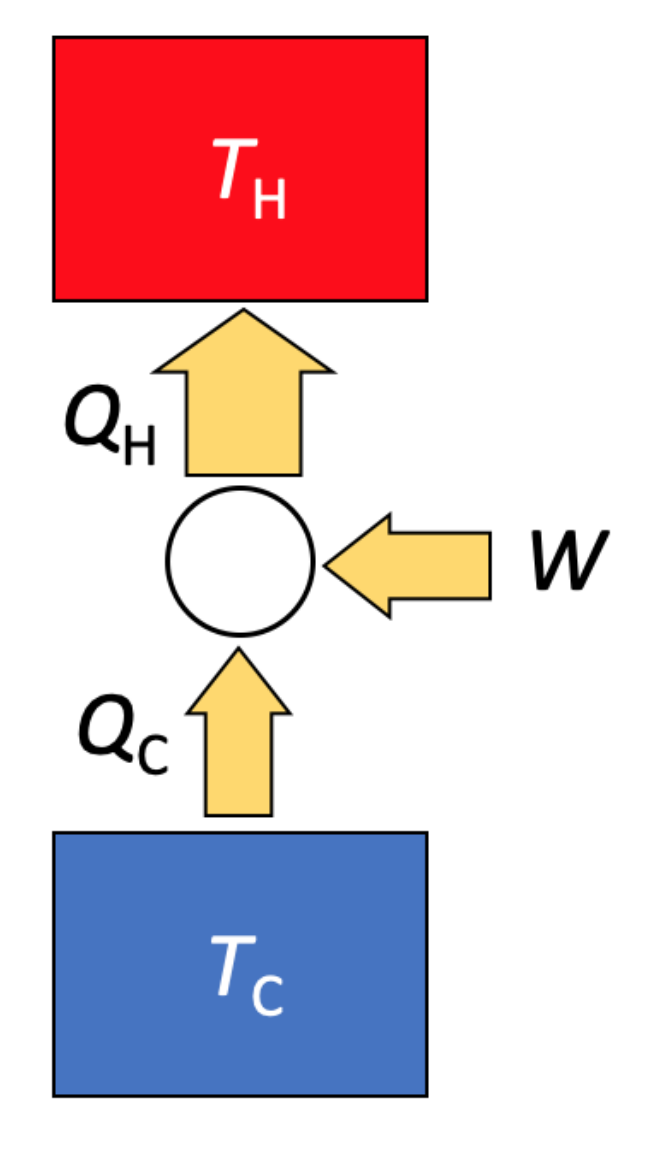
The diagram shows a machine (the white circle) that moves energy from a cold reservoir to a hot reservoir. We will consider whether a machine like this is useful for heating a family home in the winter when the temperature inside the family home is \(T_\text{H}\), and the temperature outside the house is \(T_\text{C}\). To quantify the performance of this machine, I'm interested in the ratio \(Q_\text{H}/W\), where \(Q_{\text{H}}\) is the heat energy entering the house, and \(W\) is the net energy input in the form of work. (\(W\) is the energy I need to buy from the electricity company to run an electric motor). Starting from the 1\(^{\text{st}}\) and 2\(^\text{nd}\) laws of thermodynamics, find the maximum possible value of \(Q_\text{H}/W\). This maximum value of \(Q_\text{H}/W\) will depend solely on the ratio of temperatures \(T_\text{H}\) and \(T_\text{C}\).
We are tring to maximize the heat flowing into the high temperature reservoir for a given amount of work input. By the first law of thermodynamics we know that
\[Q_{\text{C}}+W = Q_{\text{H}}\]
If I fix W, then increasing \(Q_{\text{C}}\) will increase \(Q_\text{H}\).
By the second law of thermodynamics we know \begin{align} -\frac{Q_{\text{C}}}{T_{\text{C}}} + \frac{Q_{\text{H}}}{T_{\text{H}}} \geq 0 \end{align}
If we use the beggest \(Q_{\text{C}}\) then \begin{align} \frac{Q_{\text{C}}}{T_{\text{C}}} = \frac{Q_{\text{H}}}{T_{\text{H}}}\\ \rightarrow \frac{Q_{\text{C}}}{Q_{\text{H}}} = \frac{T_{\text{C}}}{T_{\text{H}}} \end{align}
We can combine the two equations to get the efficiency: \begin{align*} \epsilon = \frac{Q_\text{H}}{W} &= \frac{Q_\text{H}}{Q_\text{H}-Q_\text{C}}\\[6pt] \frac{1}{\epsilon} &= \frac{Q_\text{H}-Q_\text{C}}{Q_\text{H}} \\[6pt] &= 1- \frac{Q_\text{C}}{Q_\text{H}} \\[6pt] &= 1- \frac{T_\text{C}}{T_\text{H}} \\[6pt] &= \frac{T_{\text{H}}-T_{\text{C}}}{T_\text{H}} \\[6pt] \epsilon &= \frac{T_\text{H}}{T_{\text{H}}-T_{\text{C}}} \end{align*}
To understand this answer, I can consider a few special cases. If \(T_\text{H} = T_{\text{C}}\), then no work is needed. If \(T_{\text{C}}\rightarrow 0\), then \(Q_\text{H} = W\). All the heat must come from work.
I'm also noticing that the difference in temperature between the reservoirs is going to be smaller than the temperature of the hot reservoirs, so I'm expecting efficiencies that are bigger than 1.
Sensemaking: Choose realistic values of \(T_\text{H}\) and \(T_\text{C}\) to describe a family home on a snowy day. Based on your temperature estimates, what is the maximum possible value of \(Q_\text{H}/W\)?
For a snowy day, let \(T_{\text{C}} = 270\) K and \(T_\text{H} = 290\) K.
Substituting that into my equation, I get \(Q_\text{H}/W = 290/20 \approx 15\).
That sounds great! How well do real heat pumps perform? See wikipedia: “Heat Pump”, subsection “performance considerations.” It says that \(Q_\text{H}/W \approx 3.2-4.5\) for a unit you can install at your house.
- Water and air heat capacity
S1 5516S
In the last homework, you looked up the specific heat capacity of water and air (\(c_{\text{p,water}}\) = 4.2 J/(g.K) and \(c_{\text{p,air}}\) = 1.0 J/(g.K)) to analyze changes in the earth's climate. In this problem, you'll estimate \(c_{p\text{,water}}\) and \(c_{p\text{,air}}\) from first principles. Note: You'll use the equipartition theorem which is a coarse-grained alternative to using the full machinary of statistical mechanics, so, the answers might be off by a few %.
- For liquid water at room temperature, treat every oxygen atom and hydrogen atom as a point mass held in place by a 3-dimensional network of springs (like an Einstein solid). These “springs” arise from intra-molecular bonds (bonds within an H\(_2\)O molecule) and inter-molecular forces (the forces between neighboring H\(_2\)O molecules). Assume 1 gram of water and calculate the total number of degrees of freedom. Then find the total internal energy as a function of temperature, and the specific heat capacity at constant volume. Compare with measured value of \(c_{\text{p,water}}\). Note: Liquid water doesn't expand/contract very much when heated, so \(c_{\text{p,water}} \approx c_{\text{v,water}}\).
In this model or liquid water, each atom has 6 degrees of freedom. Three DoF are \(v_x, v_y,\) and \(v_z\) that determine kinetic energy of the atom. Three additional DoF are \(x, y,\) and \(z\) that determine the how much elastic potential is stored.
The equipartition theorem then predicts \begin{align} U &= \frac{6k_{\text{B}}T}{2}(N_{\text{hydrogen}}+N_{\text{oxygen}})\\ &= \frac{18k_{\text{B}}T}{2}N_{\text{water}}\\ \end{align}
Where \(N_{\text{water}}\) is the number of water molecules. To calculate specific heat, I need to find \(N_{\text{water}}\) for 1 gram of water:
\begin{align} N_{\text{water}} = \frac{[1 \text{ g}]}{[18 \text{ g/mol}]} N_{\text{Av}} . \end{align}
where \(N_{\text{Av}}=6\times 10^{23} \text{ mol}^{-1}\). Then, the heat capaicty of 1 gram of water at constant volume is given by
\begin{align} \frac{dU}{dT} &= \frac{18k_\text{B}}{2} N_{\text{water}} \\ &= \frac{18k_\text{B}}{2} \frac{1}{18} [6\times 10^{23}] \\ &= \frac{k_\text{B} [6\times 10^{23}]}{2} \\ &= \frac{8.314}{2} \text{ J/K} \\ &= 4.16 \text{ J/K} \end{align}
Remember this calculation was for 1 gram of water. So this model predicts that \(c_{\text{v,water}} \approx 4.16\) J/(g.K). This is very close to the experimentally measured heat capacity of liquid water at constant volume at \(T \approx 25^{ \circ}\) celcius, \(c_{\text{v,water}}=4.142 \text{ J}\cdot\text{K}^{-1}\text{g}^{-1}\).
If you are curious to explore the statistical mechanics of water in more detail, consider the solid phase (ice) and the gas phase (steam). For ice at constant pressure and \(T \approx -10^{\circ}\) celcius, \(c_{\text{p,ice}} = 2.12\) J/(g.K) \(\approx c_{\text{v,ice}}\). For steam at constant volume and \(T \approx 100^{\circ}\) celcius, \(c_{\text{v,steam}} \approx 1.53\) J/(g.K). Liquid water has the largest heat capacity of the three phases. Only in the liquid phase are neighboring water molecules constantly making and breaking hydrogen bonds with each other. In an ice crystal, the hydrogen bonds between neighboring water molecules are locked in place. In steam, the water molecules are so far apart from each other that they don't interact.
The main components of air are nitrogen and oxygen. They are both diatomic gas molecules. You can model an O\(_2\) gas molecule, or N\(_2\) gas molecule, as two point masses connected by a stiff spring. The spring is so stiff that the energy quanta needed to excite the spring is bigger than \(k_{\text{B}}T/2\) when \(T\) = 300 K. Therefore, you can treat the spring like a rigid rod. Calculate the total number of degrees of freedom in 1 gram of air. Then find the total internal energy as a function of temperature, and the specific heat capacity at constant volume. Compare with measured value of \(c_{\text{v,air}} = 0.717\) J/(g.K). Note, \(c_{\text{p,air}}\) is about 40% higher than \(c_{\text{v,air}}\) because air held at constant pressure converts a sizable fraction of the heat into work when the gas expands.
This solution hasn't been written yet.
- For liquid water at room temperature, treat every oxygen atom and hydrogen atom as a point mass held in place by a 3-dimensional network of springs (like an Einstein solid). These “springs” arise from intra-molecular bonds (bonds within an H\(_2\)O molecule) and inter-molecular forces (the forces between neighboring H\(_2\)O molecules). Assume 1 gram of water and calculate the total number of degrees of freedom. Then find the total internal energy as a function of temperature, and the specific heat capacity at constant volume. Compare with measured value of \(c_{\text{p,water}}\). Note: Liquid water doesn't expand/contract very much when heated, so \(c_{\text{p,water}} \approx c_{\text{v,water}}\).