Contemporary Challenges: Spring-2026
Week 10 HW (SOLUTION): Due 30 Friday
- Approx. Integral of Planck Spectrum
S1 5527S
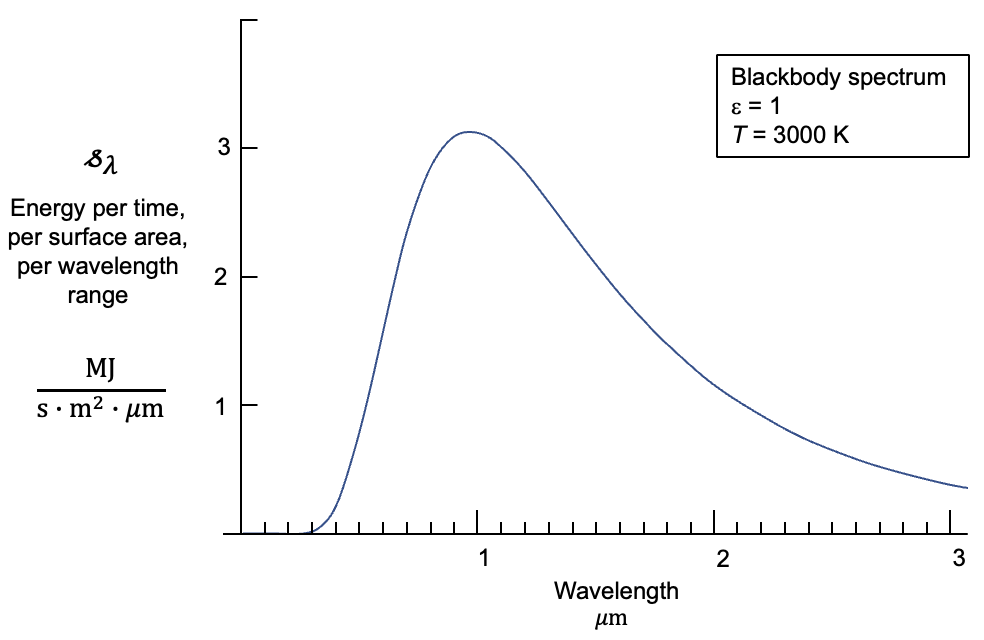
For the spectrum drawn below, estimate the integral from \(\lambda=0\) to \(\infty \) by using the height-times-width technique (you will need to estimate the full width at half maximum). Give a numerical answer with appropriate units based on the units of the x-axis and y-axis. Compare your answer to the exact value of the integral which can be quickly computed from the Stefan-Boltzman Law.
- Reentry Heating of the Space Shuttle
S1 5527S
When NASA's Space Shuttle Orbiter descends from orbit it must pass through the upper reaches of Earth's atmosphere where the air is extremely thin. In this upper atmosphere, air molecules collide with the space shuttle and cause significant heating (transfer of kinetic energy). At very high altitudes, there aren't enough air molecules for convective heat transport. At these altitudes, the primary mechanism for cooling the Orbiter is the emission of blackbody radiation.
The Orbiter has a heat shield on its underside (see the black panels in the photo at the bottom of the page). This heat shield reaches a temperature of 2000 K. The topside of the Orbiter stays cool (\(\approx\) 300 K).

Estimate the maximum rate of decent of the shuttle through the upper atmosphere (the decrease in elevation per unit time). The primary constraint is that the temperature of the heat shield cannot safely exceed 2000 K (glowing red hot). This estimate will require a few steps:
At what rate is blackbody radiation emitted from the Orbiter's heat shield when its underside reaches a temperature of 2000 K? Give your answer in J/s.
Note: the space shuttle is about 35 m long, and has a wingspan (from wingtip to wingtip) of 25 m.
We want to know the rate that energy is radiated from the bottom of the space shuttle when it is at \(T=2000\text{ K}\). The surface area is approimately \((35\times25)/2\text{ m}^2\). The thermal radiation emission rate is \begin{align} \sigma T^4 [440\text{ m}^2] = (5.7\times10^{-8}\text{ J/s}\cdot \text{K}^4)(2000\text{ K})^4(440\text{ m}^2) = 5\times10^8\text{ J/s} \end{align}
The Orbiter has a velocity component parallel to the Earth's surface, \(v_\parallel\), and a velocity component pointing toward the Earth's surface, \(v_\perp\). To build physical intuition about the descent, let's use reasoning and simple modeling to test some hypotheses about the dominant energy transformations involved. As a first hypothesis, we'll consider a plausible coarse-grained model: assume the Orbiter's total kinetic energy remains constant during reentry, while its gravitational potential energy decreases. Apply the First Law of Thermodynamics (conservation of energy) to estimate the maximum value of \(v_\perp\). Express your answer in units of m/s.
Note: Gravitational potential energy is changing, and electromagnetic radiation energy is being generated. The orbiter's mass is about 80,000 kg, similar to the mass of 80 cars.
If the change in K.E. is negligible, then \(m g \Delta h/\Delta t \le 5\times 10^8\text{ J/s}\), where \(m g \Delta h/\Delta t\) is the rate of change of gravitational potential energy. \begin{align} \frac{\Delta h}{\Delta t} &\le \frac{5\times10^8\text{ J/s}}{(10^5\text{ kg})(10\text{ ms}^{-2})}\\ &\le 500\text{ m/s} \end{align}
Now try analyzing the descent again, this time accounting for the changing kinetic energy of the Orbiter. Use the following information to construct a plausible coarse-grained model. As before, we're using physical reasoning to test hypotheses about the descent, but now incorporating additional detail to better reflect the energy transformations involved. Our goal is to estimate the time required for a safe descent:
Time of ignition for the de-orbit burn is about 60 minutes before landing. The burn lasts 3 to 4 minutes and slows the Orbiter enough to begin its descent. About 30 minutes before landing, the Orbiter begins to encounter the effects of the upper atmosphere and the heat shields start to heat up. This usually occurs at an altitude of about 130 km, more than 8,000 km from the landing site. At this point, the Orbiter is traveling at 7500 m/s relative to the atmosphere. Around 15 minutes before landing, it has descended to an altitude of about 10 km (comparable to the cruising altitude of commercial aircraft) and is traveling at approximately the speed of sound (340 m/s).
Using this new information about changes in velocity and altitude, estimate the time required for “braking with fire” (the hot and fiery segment of the descent). Compare to the actual timeline. What physical mechanisms are still missing from the coarse-grained model of the fiery descent? What would be a sensible next level of model refinement?
\begin{align} \text{Initial KE} &= \frac{1}{2} m v^2 = \frac{1}{2}(10^5\text{ kg})(7500\text{ m/s})^2\\ &\qquad \qquad= 3\times 10^{12}\text{ J}\\ \text{Final KE} &= \frac{1}{2}(10^5\text{ kg})(340\text{ m/s})^2 = 5\times10^9\text{ J} \end{align} Compare these numbers to the change in gravitational potential energy \begin{align} \Delta U_g &= m g \Delta h\\ &=(10^5\text{ kg})(10\text{ m s}^{-2})(1.2\times10^5\text{ m})\\ &= 1.2\times10^{11} \text{ J} \end{align} This shows that the shuttle must lose much more K.E. than gravitational potential energy. In part a, we calculated that the 2000-K heat shield can radiate energy at a rate of \(5\times10^8\text{ J/s}\). Using this rate of energy transformation, the minimum time for the space shuttle's decent would be \begin{align} \Delta t = \frac{3\times10^{12}\text{ J}}{5\times10^8\text{ J/s}} &= 0.6\times10^4\text{ s}\\ & = 6000\text{ s}\\ & = 100\text{ minutes} \end{align} This time is longer than 15 minute.
There must be something wrong with my assumptions. For a more refined description, I should consider the possibility of transferring kinetic energy to the “wind trail” behind the orbiter, especially when the atmosphere gets thicker.
We could also consider the thermal conductivity of the atmosphere, which would provide an additional mechanism for heat energy to be dissipated.
- Two-layer model for estimating the Earth’s temperature
S1 5527S
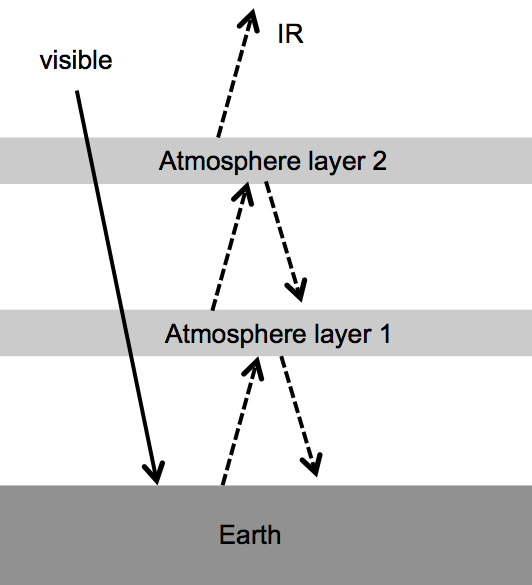
The Figure shows a two-layer model of the Earth's atmosphere. Both atmospheric layers are transparent to visible light, but fully absorb infra-red (IR) light. The atmospheric layers absorb, thermalize and re-emit infrared radiation. The temperature of each layer is stable, meaning that “power in“ is equal to “power out“ for each layer.
Write down three equations that represent the balance of power for the three objects in this model (the ground, layer 1 and layer 2). Write a fourth equation that represents the balance of power for the combined system (earth + atmosphere) which is receiving solar energy and radiating IR into outerspace. Give your answers as symbolic expressions.
The energy contained within a region must be constant if the temperature is assumed to be constant. The energy budget is found by setting the flow of energy into a region equal to the flow out. All of the powers are depicted in the picture below.
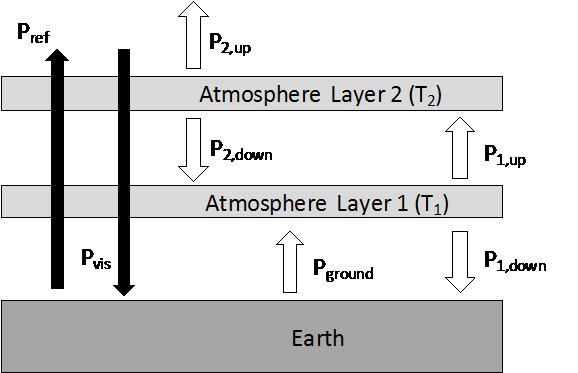
The energy budget is given by the following set of equations:
- Earth: \(P_{\text { vis }}=P_{\text { reflect }}+P_{2, \text { up }}\)
- Shell \(1 : P_{1, \mathrm{up}}+P_{1, \mathrm{down}}=P_{2, \text { down }}+P_{\text { ground }}\)
- Shell \(2 : P_{2, \mathrm{up}}+P_{2, \text { down }}=P_{1, \text { up }}\)
- Ground: \(P_{\text { vis }}+P_{1, \text { down }}=P_{\text { ref }}+P_{\text { ground }}\)
Note: \(P_{2, \text { up }}=P_{2, \text { down and }} P_{1, \text { up }}=P_{1, \text { down }}\) since both layers are assumed to be at a constant temperature.
- Find the temperature of the earth's surface when the intensity of incoming sunlight is 1360 J/(s.m\(^2\)). Note that 30% of this sunlight is reflected immediately back into outerspace.
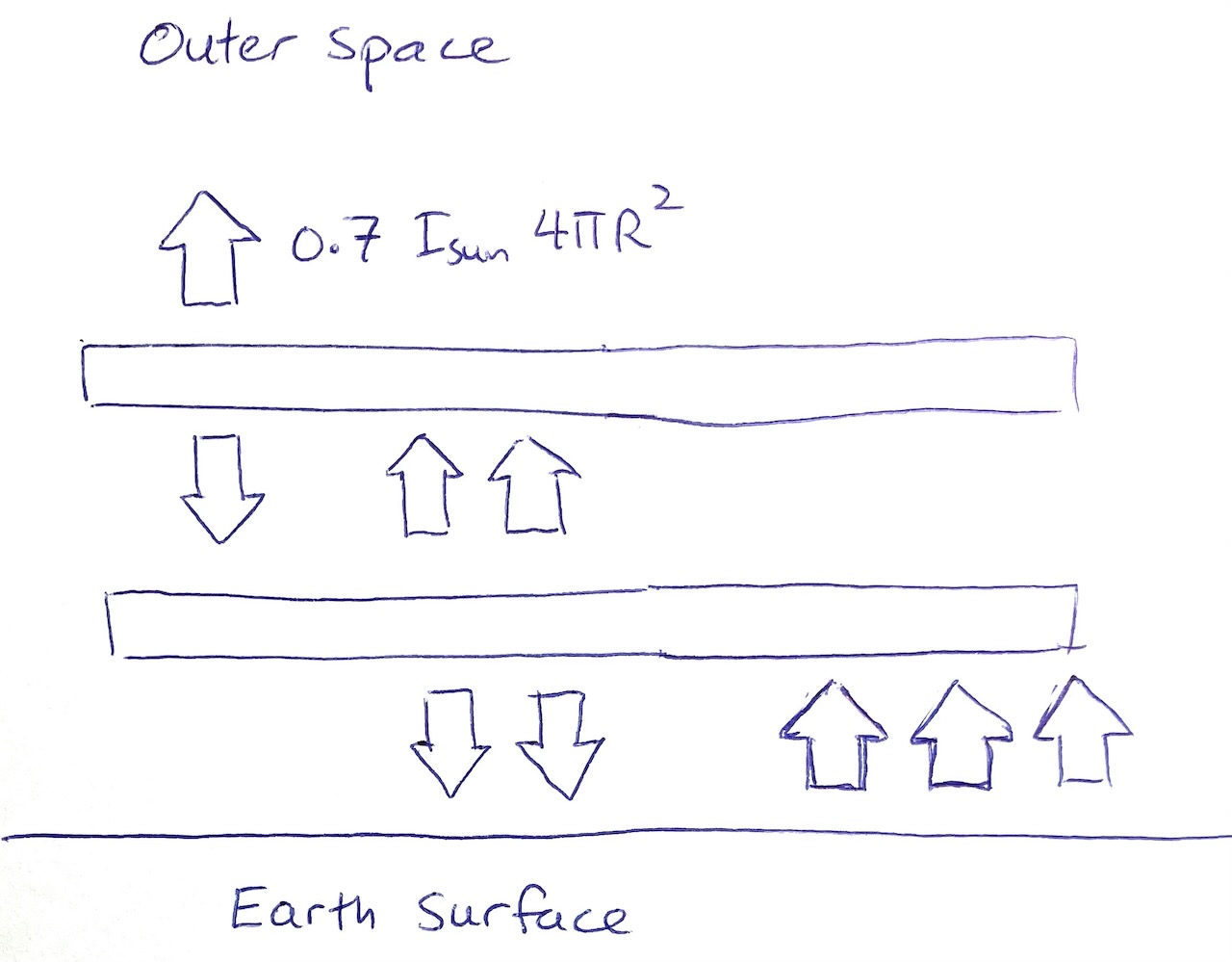
The temperature of the earth's surface will be \begin{align} T=\left(3\cdot\frac{0.7I_{\text{sun}}}{4\sigma}\right)^{1/4}=3^{1/4}[255 \text{ K}]=336 \text{ K}. \end{align} The figure below is useful for visualizing why the factor 3 arises in this solution. Note, every arrow in this diagram corresponds to a power of \(0.7I_{\text{sun}}4\pi R^2\).
Optional, not graded Find the upward IR flux that is emitted into outer space as a function of the ground temperature. Give you answer as a symbolic expression.
Assuming the earth reflects 30\(\%\) of sunlight, \(P_{\text { reflect }}=0.3 P_{\text { vis. }}.\) Therefore, the first equation becomes \(0.7 P_{\text { vis }}=P_{2, \text { up }}=(0.7) \cdot\left(1350 \frac{\mathrm{W}}{\mathrm{m}^{2}}\right) \cdot \pi R_{\mathrm{e}}^{2}\) where \(R_{\mathrm{e}}\) is the radius of the earth. The temperature of the second layer \(\left(T_{2}\right)\) can be found using the Stefan-Boltzmann law. \(P_{2, \text { up }}=(0.7) \cdot\left(1350 \frac{\mathrm{W}}{\mathrm{m}^{2}}\right) \cdot \pi R_{\mathrm{e}}^{2}=\sigma T_{2}^{4} \cdot 4 \pi R_{\mathrm{e}}^{2}.\) The distance between the ground and atmospheric layers is negligible compared to the size of the earth. The earth radiates over it's full surface area, but only absorbs sunlight that hits the side facing the sun.
Solving for the temperature of the second layer results in \(T_{2}=\left(\frac{0.7 \cdot 1360}{4 \sigma}\right)^{1 / 4}=255 \mathrm{K}\)
From Equation 3 and the note at the bottom of part a) \(, P_{1, \mathrm{up}}=2 P_{2, u p}=\sigma T_{1}^{4} \cdot 4 \pi R_{e}^{2}\) which implies that \(T_{1}^{4}=2 T_{2}^{4}\).
Rearranging Equation 2) gives \(P_{\text { ground }}=2 P_{1, \text { up }}-P_{2,\text{up}}.\) This implies that \(T_{\text { ground }}^{4}=\) \(2 T_{1}^{4}-T_{2}^{4}.\) Using the result from part b), this becomes \(T_{\text { ground }}^{4}=3 T_{2}^{4}\) which implies that \(T_{\text { ground }}=335 \mathrm{K}\). On Day \(25,\) you showed in class that a single layer atmosphere model (with the same assumptions) predicted a ground temperature of 303 \(\mathrm{K}\). Therefore, the green house effect is larger with two layers.
Optional, not graded Calculate the upward IR flux when the ground temperature is 300 K.
NOSOL
- Infrared light interacting with gases in the atmosphere
S1 5527S
This question uses web-based software called MODTRAN which was published by Prof. David Arche (Univ. of Chicago). MODTRAN calculates how much infrared (IR) radiation leaves the Earth's atmosphere and travels away into outer space. This quantity is called “upward IR heat flux”. Open the webpage and switch the graph to wavelength. You can play with the model inputs.
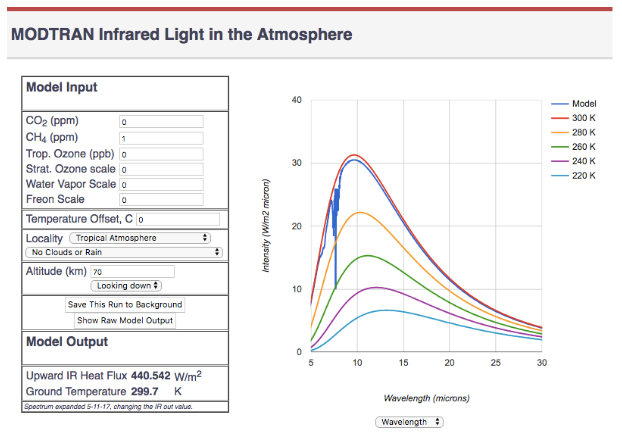
https://climatemodels.uchicago.edu/modtran/ We will investigate the role of methane in the atmosphere. Methane has an absorption cross-section of about \(10^{-11} \ \mu\text{m}^2\) at a wavelength of about \(8\ \mu\text{m}\) (for comparison, \(\text{CO}_2\) has an absorption cross-section of about \(10^{-11}\ \mu\text{m}^2\) at \(15\ \mu\text{m}\)). The concentration of methane in our atmosphere is currently about 2 ppm.
- Make a pen-and-paper estimate (no computer modelling) for the optical depth of the atmosphere when light has wavelength \(8\ \mu\text{m}\) and the atmosphere contains 2 ppm methane. Assume standard temperature and pressure, and a methane absorption cross section of \(10^{-11} \ \mu\text{m}^2\) . Give your answer in meters.
At sea level, I'll find how many air molecules per unit volume. The pressure in \(100\text{ kPa} = 10^5\text{ N/m}^2\). \begin{align} &p V = N_{tot} k_b T\\ &\frac{N_{tot}}{V} = \frac{p}{k_b T} = \frac{10^5\text{ N/m}^2}{(1.4\times10^{-23}\text{ J/K})(300\text{ K})} = 2.4\times10^{25}\text{ m}^{-3} \end{align} A small fraction of these molecules are methane, 2 ppm. \begin{align} &\frac{N_{tot}}{V} = (2\times10^{-6})(2.4\times10^{25})= 4.8\times10^{19}\text{ m}^{-3} \end{align} The absorption cross section is \(10^{-11}\ \mu\text{m}^2 = 10^{-23}\text{ m}^2\) \begin{align} \text{optical depth} &\approx \frac{1}{(5\times10^{19})(10^{-13})}\text{ m}\\ &= \frac{1}{5\times10^{-4}}\text{ m}\\ &= 2000\text{ m} \end{align}
- Use the computer model to remove all greenhouse gases from the atmosphere except for methane. Set methane to 2 ppm. Then try increasing methane to 4 ppm. What is the change in the “upward IR heat flux” when you change from from 2 to 4 ppm?
Adjusting methane concentration:
At 2 ppm, upward IR heat flux is \(438.972\text{ W/m}^2\).
At 4 ppm, upward IR heat flux is \(437.088\text{ W/m}^2\).
This corresponds to a decrease of \(1.884\text{ W/m}^2\). - Now we will check what happens when the \(\text{CO}_2\) concentration is increased by 2 ppm. Use the computer model to remove all greenhouse gases from the atmosphere except for \(\text{CO}_2\) (set \(\text{CO}_2\) to 410 ppm). Increase the \(\text{CO}_2\) concentration to 412 ppm. What is the change in the “upward IR heat flux”? (The online user interface might not show you enough significant figures. If this is the case, increase \(\text{CO}_2\) from 410 to 430 ppm and then do a linear interpolation to estimate the change between 410 and 412 ppm).
Adjusting \(\text{CO}_2\) concentration:
At 410 ppm, upward IR heat flux is \(400.350\text{ W/m}^2\).
At 430 ppm, upward IR heat flux is \(400.036\text{ W/m}^2\).
This corresponds to a decrease of \(0.314\text{ W/m}^2\)
Now, if I was to change from \(410\text{ ppm}\rightarrow412\text{ pmm}\) I expect a decrease of \(0.0314\text{ W/m}^2\). Methane is much more “potent” than the \(\text{CO}_2\). - Try to explain the results of part b and c to a non-scientist. You may want to use the concepts of “optical depth” and “saturating an absorption dip”.
There is already a high concentration of \(\text{CO}_2\) in the atmosphere. Thus, a broad band of wavelengths (from \(14\ \mu\text{m} - 16\ \mu\text{m}\)) has an optical depth less than \(1\text{ km}\). Due to this short optical depth, the absorption dip is saturated for wavelengths between \(14\ \mu\text{m} - 16\ \mu\text{m}\). 2 ppm more \(\text{CO}_2\) makes a fairly subtle difference, it slightly widens that wavelength range that is saturated.
In contrast, the low concentration of \(\text{CH}_4\) doesn't saturate the absorption dip. Adding 2 ppm more \(\text{CH}_4\) makes a significant change to both the depth and width of absorption dip.
For additional information about greenhouse gases, I recommend the highly accessible/readable Chapter 4 from Prof. Archer's textbook "Global Warming: Understanding the Forecast".
- Make a pen-and-paper estimate (no computer modelling) for the optical depth of the atmosphere when light has wavelength \(8\ \mu\text{m}\) and the atmosphere contains 2 ppm methane. Assume standard temperature and pressure, and a methane absorption cross section of \(10^{-11} \ \mu\text{m}^2\) . Give your answer in meters.