Static Fields: Fall-2026
HW 01 Practice (SOLUTION): Due W1 D3: Math Bits
- Vector Field Sketch (Rectangular Coordinates)
More practice for seeing the shape of vector fields, based on their algebraic form. These examples are in rectangular coordinates. You have some examples in cylindrical and spherical coordinates to turn in.
Sketch each of the vector fields below.
- \(\boldsymbol{\vec F} =-y\,\boldsymbol{\hat x} + x\,\boldsymbol{\hat y}\)
- \(\boldsymbol{\vec G} = x\,\boldsymbol{\hat x} + y\,\boldsymbol{\hat y}\)
- \(\boldsymbol{\vec H} = y\,\boldsymbol{\hat x} + x\,\boldsymbol{\hat y}\)
-
\(\boldsymbol{\vec F}=-y\,\boldsymbol{\hat x} + x\,\boldsymbol{\hat y}=s\,\boldsymbol{\hat\phi}\)

-
\(\boldsymbol{\vec G}= x\,\boldsymbol{\hat x} + y\,\boldsymbol{\hat y}=s\,\boldsymbol{\hat s}\)

-
\(\boldsymbol{\vec H} = y\,\boldsymbol{\hat x} + x\,\boldsymbol{\hat y}\)

- Line Integral Practice
For the given vector field \(\vec{F}\), draw a path between two points for which the line integral is:
- \(\int_{path1}\vec{F}\cdot d\vec{r}>0\)
- \(\int_{path2}\vec{F}\cdot d\vec{r}<0\)
- \(\int_{path3}\vec{F}\cdot d\vec{r}=0\)
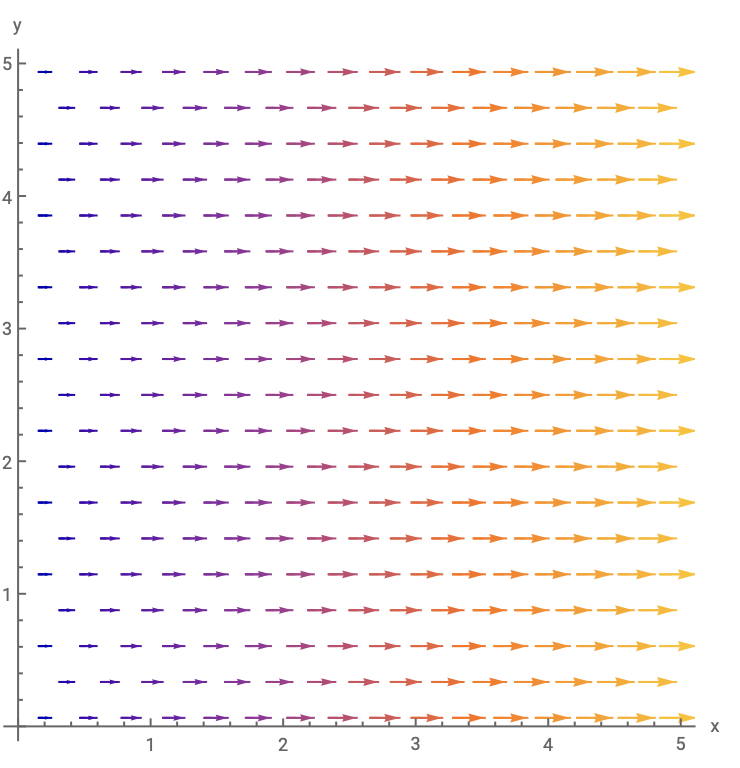
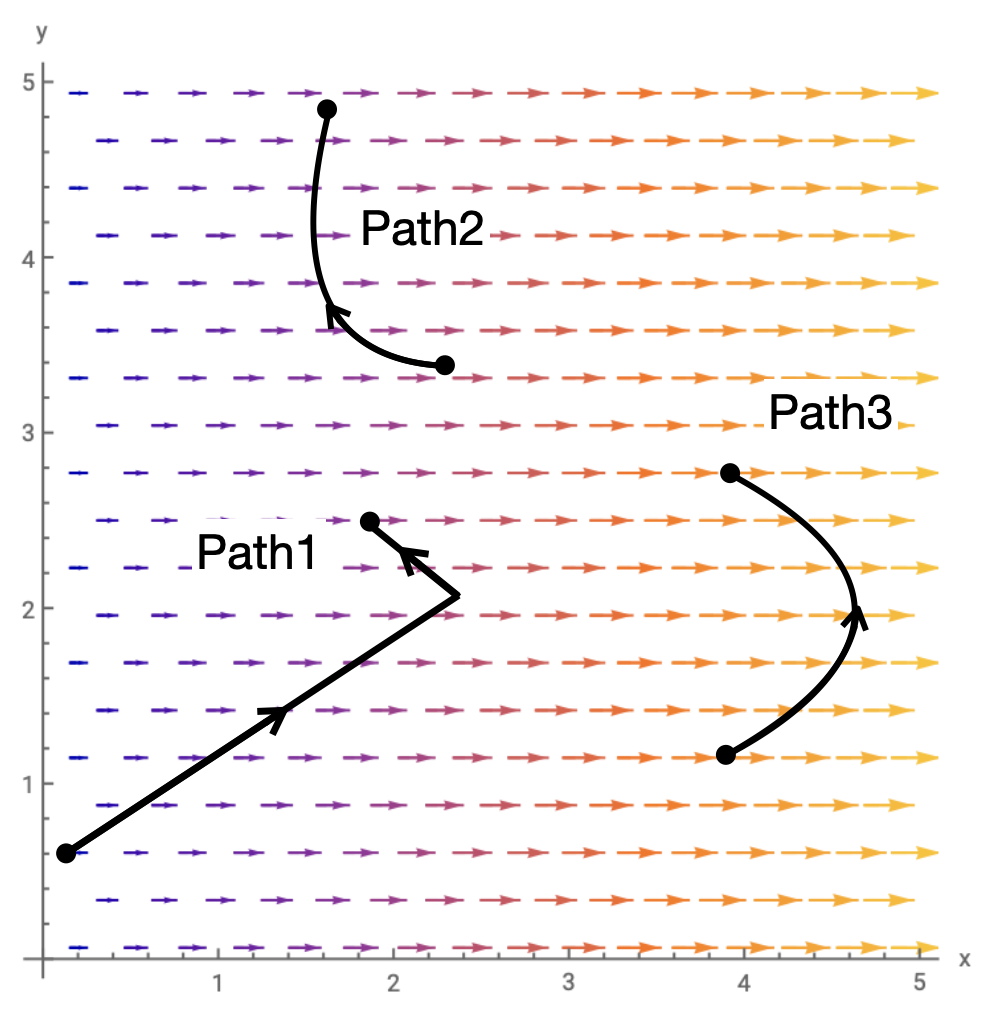
To get a positive line integral, there should more contributions from positive dot products between the differential displacements and the field than negative.
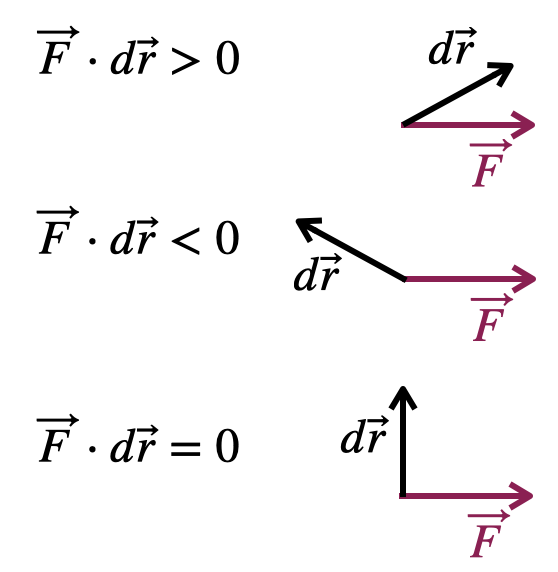
To get a negative line integral, there should be more contributions from negative dot products between the differential displacements and the field than positive.
To get a negative line integral, there should be equal contributions from positive and negative dot products between the differential displacements and the field. Or the path should be perpendicular to the field at every point.
- Curvilinear coordinate drawings
-
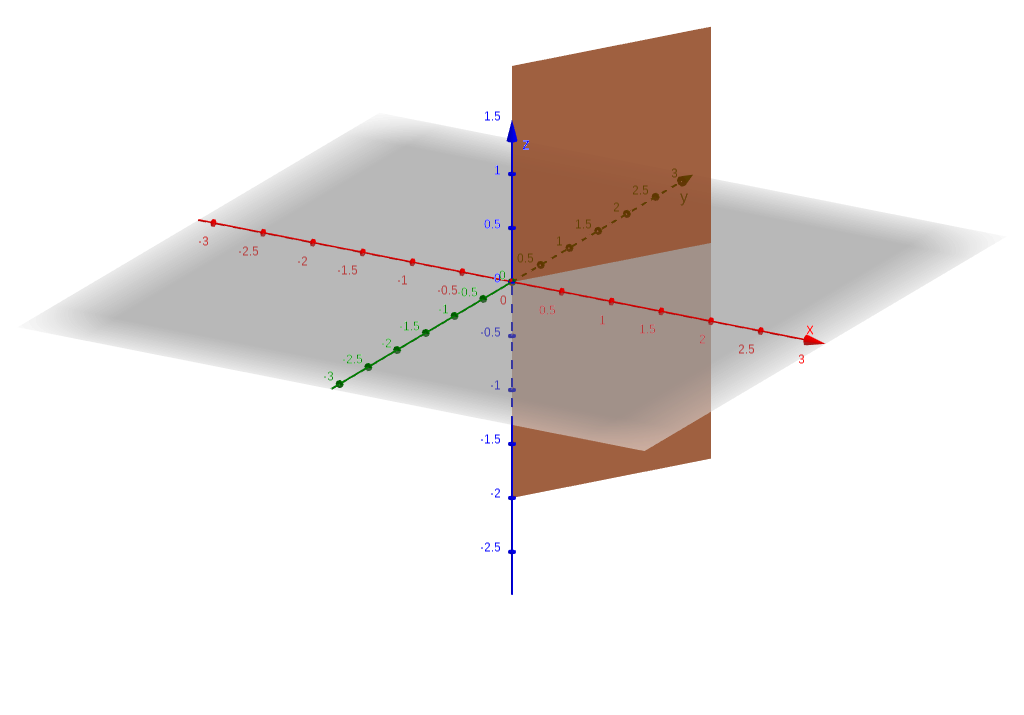
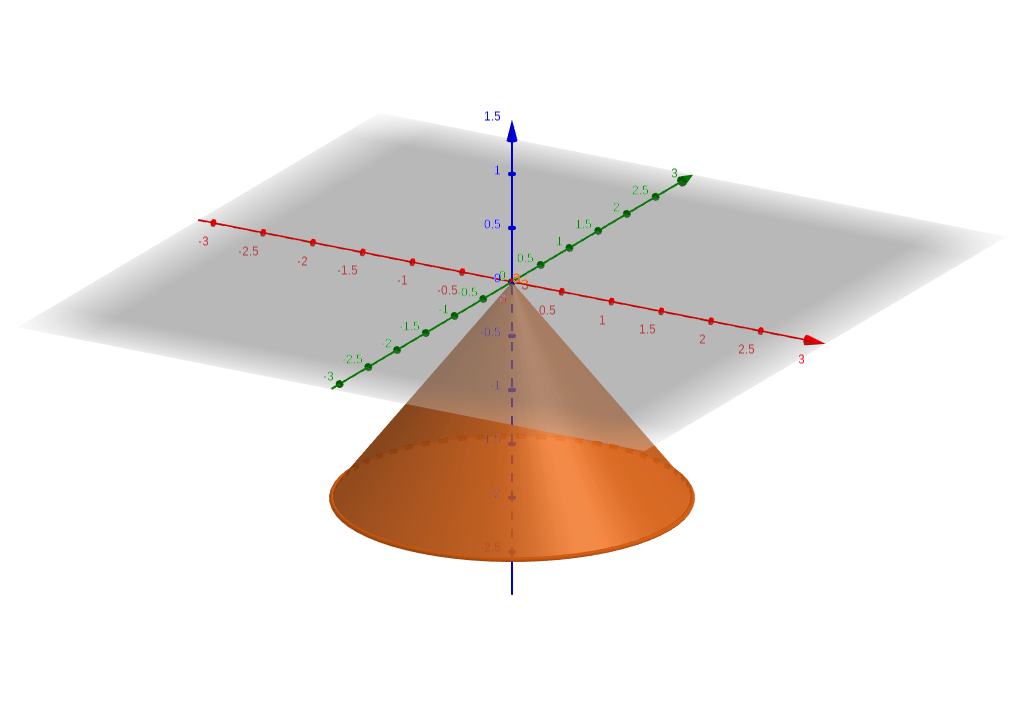
Using the conventions from class for cylindrical and spherical coordinates, draw each of the surfaces below by hand:
- \(\phi=\frac\pi3\)
- \(\theta=\frac{3\pi}4\)
-
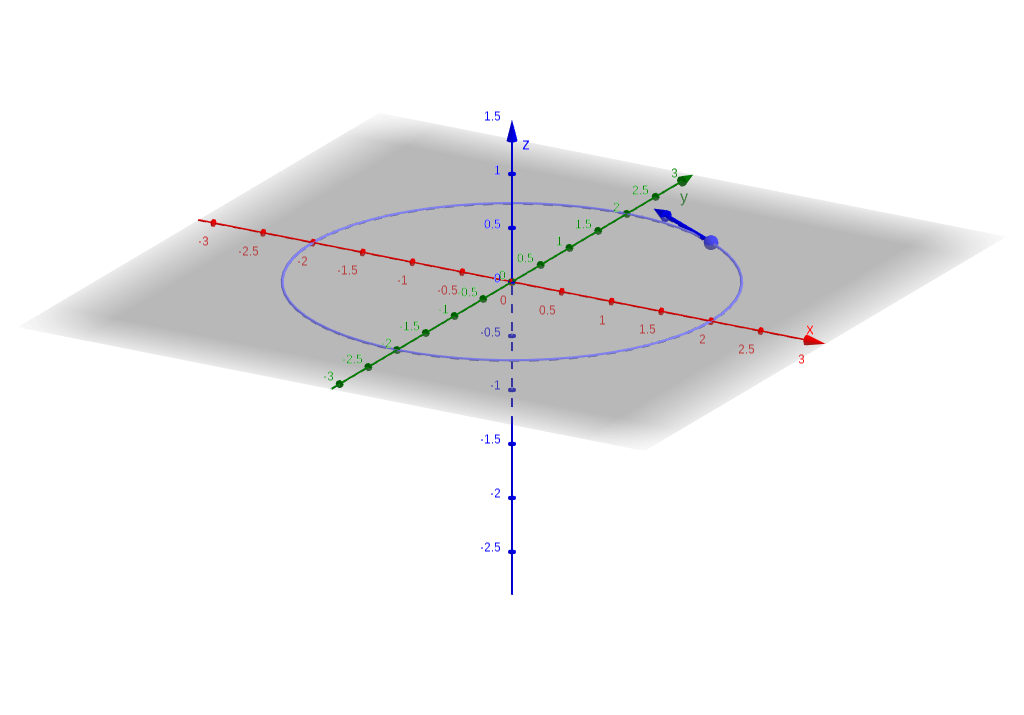
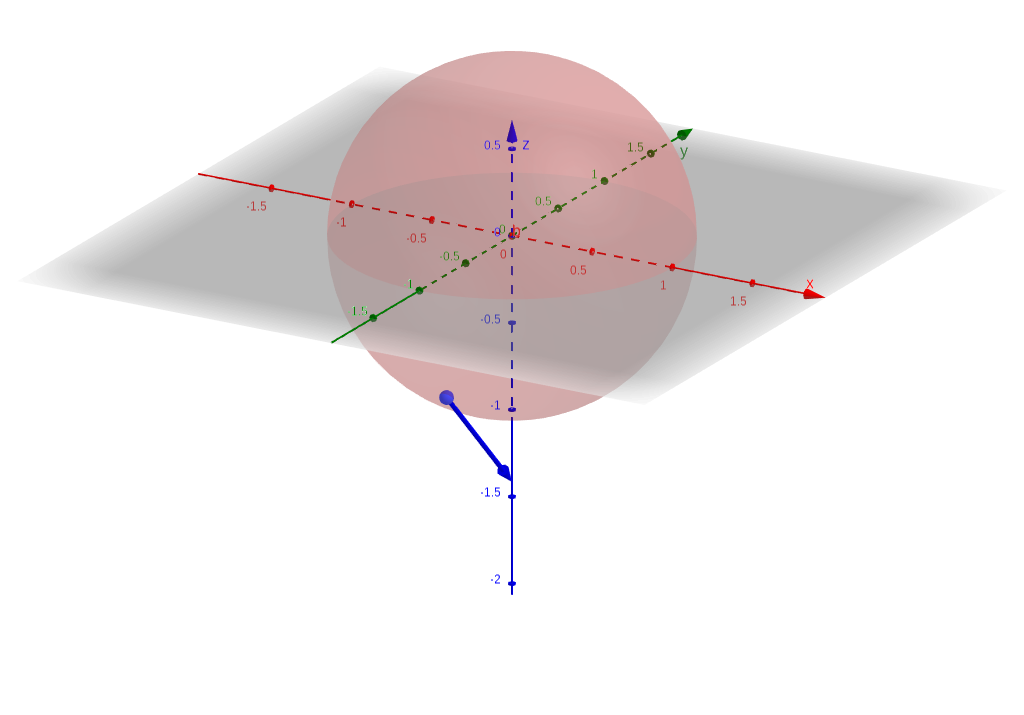
Using the conventions from class for cylindrical and spherical coordinates, draw each of the following vectors by hand at the indicated point.
- \(\boldsymbol{\hat\phi}\) at the point where \(s=2\), \(\phi=\frac\pi3\), and \(z=0\).
- \(\boldsymbol{\hat\theta}\) at the point where \(r=1\), \(\theta=\frac{3\pi}4\), and \(\phi=\frac\pi2\).
The figures below use the default orientation for GeoGebra, with the positive \(y\) axis pointing into the page.
-
Using the conventions from class for cylindrical and spherical coordinates, draw each of the surfaces below by hand:
- Exponential and Logarithm Identities Make sure that you have memorized the following identities and can use them in simple algebra problems: \begin{align*} e^{u+v}&=e^u \, e^v\\ \ln{uv}&=\ln{u}+\ln{v}\\ u^v&=e^{v\ln{u}} \end{align*}
- Derivative Rules
Make sure that you have memorized or can quickly find the derivative of all of the common transcendental functions: powers, trigonometric functions (especially sine and cosine), exponential, logarithms. Make sure that you can use these rules, even when the argument has parameters in it, e.g. \(\sin{kx}\). Also, make sure you can use the chain rule.
If you don't have these memorized, at least have a place that you can quickly locate them online or in a textbook.
- Basic Calculus: Practice Exercises
Determine the following derivatives and evaluate the following integrals, all by hand. You should also learn how to check these answers on Wolfram Alpha.
- \(\frac{d}{du}\left(u^2\sin u\right)\)
Use the product rule: \begin{align} \frac{d}{du}\left(u^2\sin u\right) &=\left(\frac{d}{du}u^2\right)\sin(u)+u^2\frac{d}{du}(\sin u)\\ &=2u\,\sin u+u^2\cos u \end{align}
- \(\frac{d}{dz}\left(\ln(z^2+1)\right)\)
Use the chain rule: Setting \(w=z^2+1\), \begin{align} \frac{d}{dz}\left(\ln(z^2+1)\right) &=\frac{d}{dz}(\ln w)\\ &=\frac{d}{dw}(\ln w)\frac{dw}{dz}\\ &=\left(\frac1w\right)(2z)\\ &=\frac{2z}{z^2+1} \end{align}
Use the "onion" rule: \begin{align} \frac{d}{dz}\left(\ln(z^2+1)\right) &=\frac{1}{z^2+1}\frac{d}{dz}(z^2+1)\\ &=\frac{2z}{z^2+1} \end{align}
- \(\displaystyle\int v\cos(v^2)\,dv\)
Use substitution! Set \(w=v^2\), \(dw=2v\,dv\), and thus \begin{align} \int v\cos(v^2)\,dv &=\frac12\int \cos(w)\,dw\\ &=\frac12\sin(w)+C\\ &=\frac12\sin(v^2)+C\\ \end{align}
- \(\displaystyle\int v\cos v\,dv\)
Use integration by parts! Setting \(p=v\) and \(dq=\cos v\,dv\), \(dp=dv\) and \(q=\sin v\), so \begin{align} \int v\cos v\,dv &=\int p\,dq = \left. pq\right\vert_{\rm{boundary}} - \int q\,dp\\ &= \left. v\sin v\right\vert_{\rm{boundary}}-\int \sin v\,dv\\ &= \left. v\sin v\right\vert_{\rm{boundary}} + \left. \cos v\right\vert_{\rm{boundary}} \end{align}
- \(\frac{d}{du}\left(u^2\sin u\right)\)