Static Fields: Fall-2026
HW 01 (SOLUTION): Due W1 D3: Math Bits
- Vector Field Sketch (Curvilinear Coordinates)
Sketch each of the vector fields below by hand. You can check your answers using technology. Make sure that you show enough arrows to show the key features of the graph.
- \(\boldsymbol{\vec K}=s\,\boldsymbol{\hat s}\)
- \(\boldsymbol{\vec M}=\sin\phi\,\boldsymbol{\hat s}\)
- \(\boldsymbol{\vec N}=\sin(2\pi s)\,\boldsymbol{\hat\phi}\)
-
\(\boldsymbol{\vec K}=\boldsymbol{\vec K}=s\,\boldsymbol{\hat s}\)
The arrows point radially outward and get larger linearly with distance from the origin.

\(\boldsymbol{\vec M}=\sin\phi\,\boldsymbol{\hat s}\)
The vectors all point radially outward. Their magnitudes depend on the angle: \(\sin\phi\) is zero along the \(x \)-axis and a maximum along the \(y\)-axis.
The arrows point tangent to circles (around and around). Their magnitudes vary like the sine of their distance from the origin.

-
\(\boldsymbol{\vec N}=\sin(2\pi s)\,\boldsymbol{\hat\phi}\)

- Circulation I
The circulation of a vector field \(\boldsymbol{\vec F}\) around a closed curve \(C\) is given by \[\oint_C\boldsymbol{\vec F}\cdot d\boldsymbol{\vec r}\]
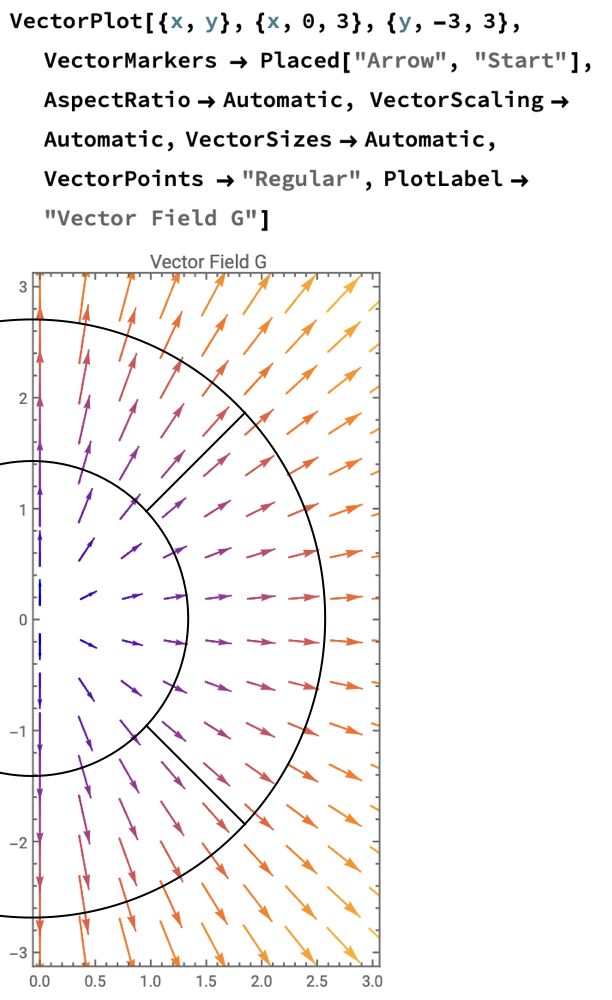
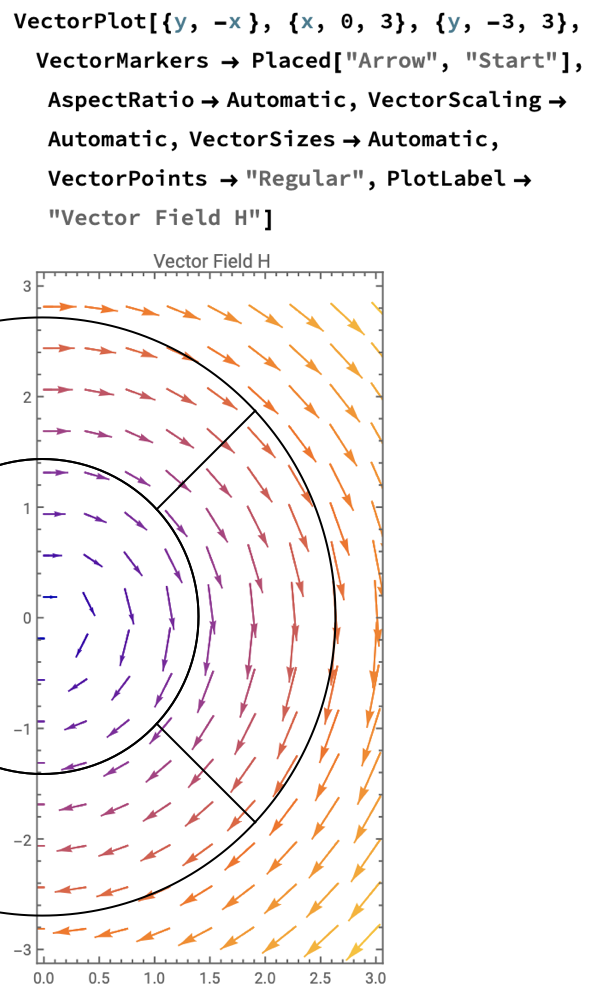
For each of the vector fields below, explain whether you expect the given vector field to have positive, negative, or zero circulation counterclockwise around the closed curve \(C\) shown in the figure. Two of the segments of \(C\) are circular arcs centered at the origin; the other two are radial line segments. \begin{align*} \hbox{I.}~~\boldsymbol{\vec G} &= x\,\boldsymbol{\hat x} + y\,\boldsymbol{\hat y} \\ \hbox{II.}~\boldsymbol{\vec H} &= y\,\boldsymbol{\hat x} - x\,\boldsymbol{\hat y} \end{align*}
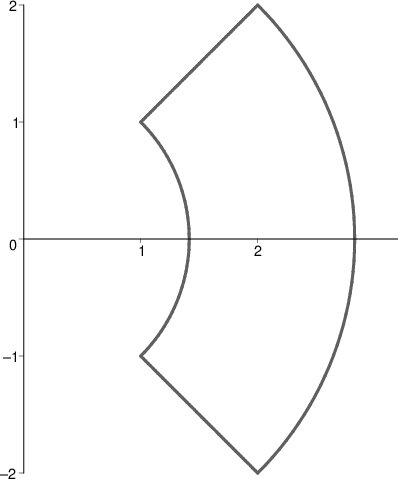
Path for Problem Circulation I The first vector field, \(\boldsymbol{\vec G}\), is radial, so there is no contribution to the line integral from the circular arcs. Since the two radial segments are traversed in opposite directions, those contributions will cancel. Thus, \(\oint_C\boldsymbol{\vec G}\cdot d\boldsymbol{\vec r}=0\).
The second vector field, \(\boldsymbol{\vec H}\), circulates around the origin, so there is no contribution to the line integral from the radial segments. The two circular arcs are traversed in opposite directions, so those contributions will have opposite sign. However, not only is the magnitude of \(\boldsymbol{\vec H}\) larger on the outer circle, that arc is also longer, so the contribution along this arc dominates the integral. Since the curve is being traversed in a counterclockwise direction, but \(\boldsymbol{\vec H}\) points clockwise, \(\oint_C\boldsymbol{\vec H}\cdot d\boldsymbol{\vec r}<0\).
- Memorize the Vector Differential
Nothing to turn in.
Write \(\vec{dr}\) in rectangular, cylindrical, and spherical coordinates.
-
Rectangular:
\begin{equation}
\vec{dr}=
\end{equation}
\begin{equation} \vec{dr}=dx\,\hat{x}+dy\,\hat{y}+dz\,\hat{z} \end{equation}
-
Cylindrical:
\begin{equation}
\vec{dr}=
\end{equation}
\begin{equation} \vec{dr}=ds\,\hat{s}+s\,d\phi\,\hat{\phi}+dz\,\hat{z} \end{equation}
-
Spherical:
\begin{equation}
\vec{dr}=
\end{equation}
\begin{equation} \vec{dr}=dr\,\hat{r}+r\,d\theta\,\hat{\theta}+r\,\sin\theta\,d\phi\,\hat{\phi} \end{equation}
-
Rectangular:
\begin{equation}
\vec{dr}=
\end{equation}