Periodic Systems: Spring-2026
HW 3 (SOLUTION): Due Day 8
- Fourier Transform of a Gaussian
S1 5494S
Consider the Gaussian wave function \(f(x) = N e^{-x^2/2{\sigma}^2}\).
- Find the normalization constant \(N\). Write a sentence describing the physical meaning of normalizing. (The identity \(\int_{-\infty}^{\infty}e^{-u^2}du = \sqrt{\pi}\) may prove helpful.)
The normalization constant arises from the relationship between the wave function and probability. The complex square of the wave function is the position-space probability density. If we integrate the probability density over all space, then the result should be 1 because the particle must be found to have some value of position.
\(1 = \int_{-\infty}^{\infty}f^*(x)f(x)dx = \int_{-\infty}^{\infty} |N|^2 e^{-x^2/{\sigma}^2} dx\)
We can use the substitution \(u = x/{\sigma}\) to simplify the integral into the form of the given identiy.
\(1 = |N|^2 {\sigma} \int_{-\infty}^{\infty} e^{-u^2} du = |N|^2 {\sigma}\sqrt{\pi}\)
\(N = \left(\frac{1}{{\sigma}^2\pi}\right)^{1/4}\)
Where we have chosen the normalization constant to be wholly real and positive.
- Find the Fourier transform of \(f(x)\) by hand. You will need to “complete the square”. Sense-making: Discuss how changing the constant \({\sigma}\) changes the shape of both \(f(x)\) and its Fourier transform.
\(\tilde{f}(k) = \frac{1}{\sqrt{2\pi}}\int_{-\infty}^{\infty}f(x)e^{-ikx}dx\)
\(\tilde{f}(k) = \frac{N}{\sqrt{2\pi}}\int_{-\infty}^{\infty}e^{-x^2/2{\sigma}^2} e^{-ikx}dx = \frac{N}{\sqrt{2\pi}}\int_{-\infty}^{\infty}e^{-x^2/2{\sigma}^2 - ikx}dx\)
We can use the substitution \(u = x/\sqrt{2}{\sigma}\) to simplify the integral.
\(\tilde{f}(k) = \frac{N{\sigma}}{\sqrt{\pi}}\int_{-\infty}^{\infty}e^{-u^2 - ik\sqrt{2}{\sigma}u}du\)
Here we must “complete the square” in order to make a perfect square in the exponent.
\(\tilde{f}(k) = \frac{N{\sigma}}{\sqrt{\pi}}\int_{-\infty}^{\infty}e^{-u^2 - ik\sqrt{2}{\sigma}u - (ik{\sigma}/\sqrt{2})^2 + (ik{\sigma}/\sqrt{2})^2}du\)
\(\tilde{f}(k) = \frac{N{\sigma}}{\sqrt{\pi}}\int_{-\infty}^{\infty}e^{-(u - ik{\sigma}/\sqrt{2})^2 + (ik{\sigma}/\sqrt{2})^2}du\)
\(\tilde{f}(k) = \frac{N{\sigma}}{\sqrt{\pi}}e^{(ik{\sigma}/\sqrt{2})^2}\int_{-\infty}^{\infty}e^{-(u - ik{\sigma}/\sqrt{2})^2}du\)
The substitution \(v = u - ik{\sigma}/\sqrt{2}\) further simplifies the integral to our familiar identity.
\(\tilde{f}(k) = \frac{N{\sigma}}{\sqrt{\pi}}e^{-k^2{\sigma}^2/2}\int_{-\infty}^{\infty}e^{-v^2}dv = \left(\frac{{\sigma}^2}{\pi}\right)^{1/4}e^{-k^2{\sigma}^2/2}\)
How interesting! The Fourier transform of the Gaussian wave function is in fact another Gaussian function, only this time with the variable \(k\) instead of the variable \(x\). Notice that the \({\sigma}\) has moved from the denominator of the exponent to the numerator. Increasing \({\sigma}\) therefore has opposite impacts on the shapes of the two functions---an increase in \({\sigma}\) makes \(f(x)\) wider, but it makes \(\tilde{f}(k)\) narrower.
- Show that the Fourier transform of \(f(x)\) is also normalized. (This is true for any function and is known as Parseval's identity.) Write a sentence describing the physical meaning of normalizing in this case.
\(\int_{-\infty}^{\infty}\tilde{f}^*(k)\tilde{f}(k)dk = \frac{{\sigma}}{\sqrt{\pi}}\int_{-\infty}^{\infty} e^{-{\sigma}^2k^2} dk\)
We can use the substitution \(u = {\sigma}k\) to simplify the integral into the form of the given identiy.
\(1 = \frac{1}{\sqrt{\pi}} \int_{-\infty}^{\infty} e^{-u^2} du = 1\)
Indeed, the Fourier transform is still normalized. In this case, we are integrating overall all values of \(k\) instead of all values of \(x\). Recall that \(k = p/\hbar\) can be interpreted as momentum in quantum mechanics, so this is equivalent to saying that the probability of finding the particle with some value of momentum between \(\infty\) and \(\infty\) is equal to 1, as it should be.
- Find the normalization constant \(N\). Write a sentence describing the physical meaning of normalizing. (The identity \(\int_{-\infty}^{\infty}e^{-u^2}du = \sqrt{\pi}\) may prove helpful.)
- Fourier Transform of Cosine and Sine
S1 5494S
- Find the Fourier transforms
of \(f(x)=\cos kx\) and \(g(x)=\sin kx\).
I will use the exponential representation of the delta function, i.e. \[ \delta(x-x_0)=\frac{1}{2\pi} \int_{-\infty}^{\infty} e^{ik(x-x_0)}\, dk \] but I will switch the variables \(x\) and \(k\). Note: Watch your signs carefully. Remember that the delta function is even and/or you may need to use the substitution \(y=-x\), \(dy=-dx\), \(x=\infty\Rightarrow y=-\infty\).
Let \(f(x)=\cos kx\). Then, the Fourier Transform is given by: \begin{align*} \tilde{f}(k^{\prime}) &= \int_{-\infty}^{\infty} \cos kx\, e^{-ik^{\prime}x}\, dx\\ &= \int_{-\infty}^{\infty} \frac{1}{2} \left(e^{i kx}+e^{-i kx}\right)\, e^{-ik^{\prime}x}\, dx\\ &= \frac{1}{2} \int_{-\infty}^{\infty} \left(e^{i (k-k^{\prime})x}+e^{-i (k+k^{\prime})x}\right)\, dx\\ &= \pi\, \left(\delta(k-k^{\prime})+\delta(k+k^{\prime})\right) \end{align*} \begin{align*} \tilde{g}(k^{\prime}) &= \int_{-\infty}^{\infty} \sin kx\, e^{-ik^{\prime}x}\, dx\\ &= \int_{-\infty}^{\infty} \frac{1}{2i} \left(e^{i kx}-e^{-i kx}\right)\, e^{-ik^{\prime}x}\, dx\\ &= \frac{1}{2i} \int_{-\infty}^{\infty} \left(e^{i (k-k^{\prime})x}-e^{-i (k+k^{\prime})x}\right)\, dx\\ &= -i\pi\, \left(\delta(k-k^{\prime})-\delta(k+k^{\prime})\right) \end{align*} Important: You cannot use the same label in the exponential in the Fourier Transform, i.e. the \(k^{\prime}\) in \(\exp(-ik^{\prime}x)\) as in the parameter in the function, i.e. the \(k\) in \(f(x)=\cos kx\). Notice how the notation for the Fourier transform \(\tilde{f}(k^{\prime})\) helps you keep track of what you have done.
- Find the Fourier transform of \(g(x)\) using the formula for the Fourier transform of a derivative and your result for the Fourier transform of \(f(x)\). Compare with your previous answer.
I can write \(\sin kx\) as a derivative of \(\cos (x)\)
\[\sin kx =-\frac{1}{k}\, \frac{d}{dx}\cos kx\]
It follows that \begin{align*} \cal{F}(\sin kx) &= \cal{F}\Big(-\frac{1}{k}\, \frac{d}{dx}\cos kx \Big) \\ &= \int_{-\infty}^{\infty}-\frac{1}{k}\, \frac{d}{dx} \cos kx\, e^{-ik^{\prime}x}\, dx \\ &= -\frac{1}{k} \int_{-\infty}^{\infty}\frac{d}{dx} \cos kx\, e^{-ik^{\prime}x}\, dx\\ &= -\frac{1}{k} \cal{F}\Big(\frac{d}{dx} \cos kx \Big) \end{align*}
According to the Fourier transform derivative formula:
\[F\Big(\tfrac{d}{dx} f(x) \Big) = ik' \tilde{f}(k')\]
Applying this property and plugging in the result from the previous part: \begin{align*} \cal{F}(\sin kx) &= -\frac{1}{k} (ik') \tilde{f}(k') \\ &=-\frac{1}{k} (ik') \pi\, \left[\delta(k-k^{\prime})+\delta(k+k^{\prime})\right] \\ &= - (i \pi)\, \frac{k'}{k}\Big[\delta(k-k^{\prime})+\delta(k+k^{\prime})\Big] \end{align*}
Notice in the second delta function that \(k\) and \(k'\) have equal magnitude but OPPOSITE signs at the peak of the delta function (i.e., the peak is happening at \(k=-k'\)). \begin{align*} \cal{F}(\sin kx) &= - (i \pi)\, \Big[\frac{k'}{k}\delta(k-k^{\prime})+\frac{k'}{k}\delta(k+k^{\prime})\Big] \\ &= - (i \pi)\, \Big[(+1)\delta(k-k^{\prime})+(-1)\delta(k+k^{\prime})\Big] \\ &= - (i \pi)\, \Big[\delta(k-k^{\prime})-\delta(k+k^{\prime})\Big] \\ \end{align*}
This changes the sign of the second term, turning the Fourier transform of the cosine (an even function) into the Fourier transform of the sine (an odd function).
- In quantum mechanics, the Fourier transform is the set of coefficients in the expansion of a quantum state in terms of plane waves, i.e. the function \(\tilde{f}(k)\) is a continuous histogram of how much each functions \(e^{ikx}\) contributes to the quantum state. What does the Fourier transform of the function \(\cos kx\) tell you about which plane waves make up this quantum state? Write a sentence or two about how this makes sense.
The Fourier transform \(\tilde{f}(k^{\prime})\) tells me which wave numbers \(k^{\prime}\) correspond to plane waves \(e^{ik^{\prime}x}\) that are present in the function \(f(x)=\cos kx\). From Euler's formula, I know that \(\cos kx\) is a linear combination of exponentials (i.e. plane waves) with only \(k\) and \(-k\) present. That is why the Fourier transform has delta functions at \(k\) and \(-k\). The Fourier transform of any (finite) linear combination of sines and cosines will always be delta functions.
- Find the Fourier transforms
of \(f(x)=\cos kx\) and \(g(x)=\sin kx\).
- Fourier Transform of a Triangle
S1 5494S
Consider a quantum mechanical wave packet shaped like a triangle:
\[ f(x)= \begin{cases} \sqrt{\frac{3}{2\epsilon^3}}\, (x+\epsilon), & -\epsilon<x<0\\ -\sqrt{\frac{3}{2\epsilon^3}}\, (x-\epsilon), & 0<x<\epsilon\\ 0, &\textrm{otherwise} \end{cases} \]
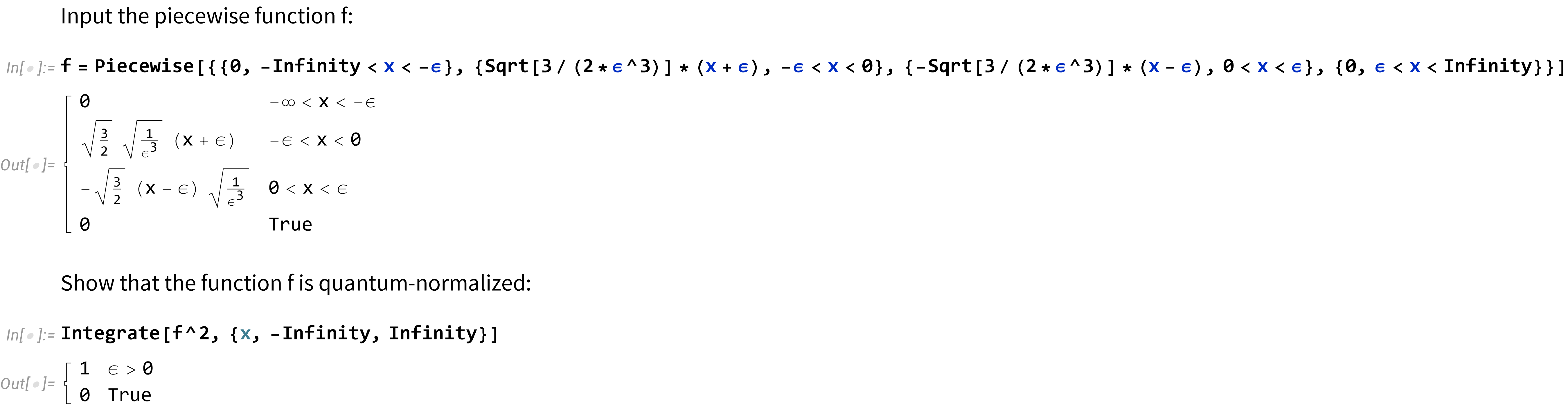
- Show that the wave packet is normalized.
I used Mathematica to do the calculations in the solutions to all of the parts of this problem. The figures show my code and output.
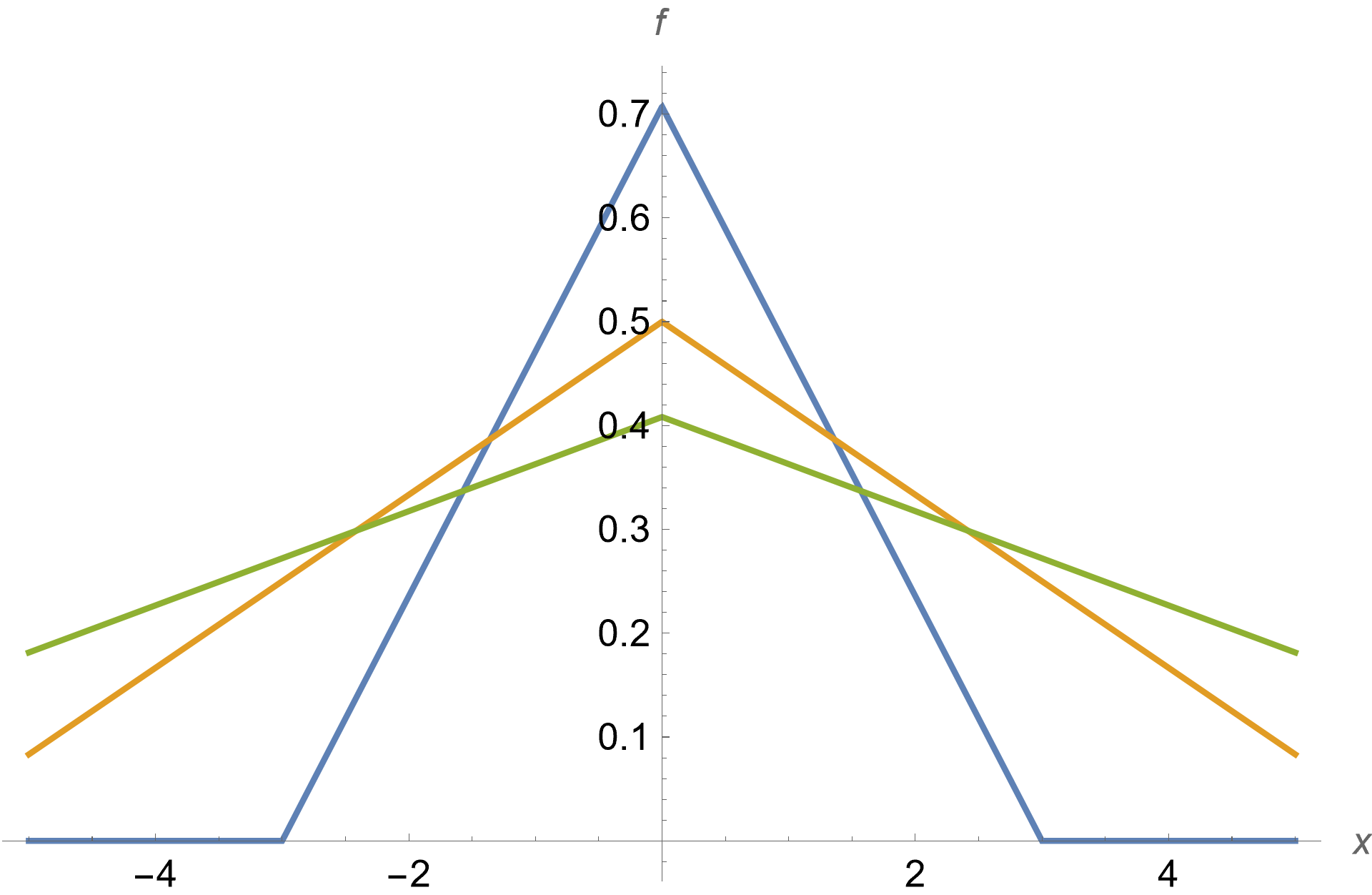
- For three different values of \(\epsilon\), plot both the wave packet. (All three plots should be on the same axes.)
- Find the Fourier Transform of the wave packet by hand. You may use
technology of your choice to evaluate integrals, but do not use any built in Fourier Transform packages.

- For three different values of \(\epsilon\), plot both the Fourier Transform of the wave packet. (All three plots should be on the same axes.)
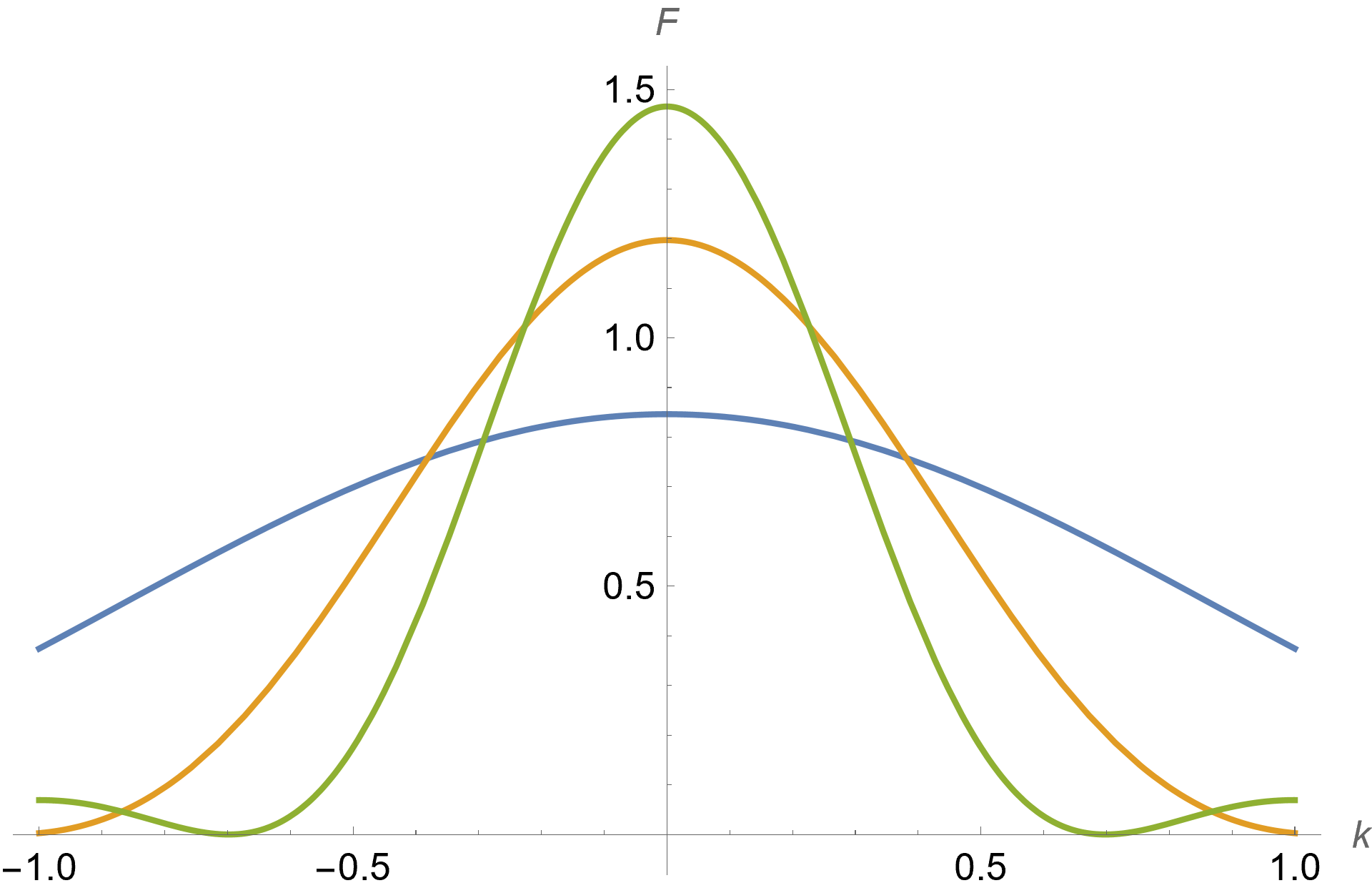
- As you change the value of \(\epsilon\) so that the packet gets narrower and taller, what happens to the shape of the Fourier Transform?
Look at the correlated colors in the graph. As the function f gets taller and narrower (green->orange->blue), the Fourier transform F gets shorter and wider.
- Show that the Fourier transform is also (norm-squared) normalized.

- Show that the wave packet is normalized.