Periodic Systems: Spring-2026
HW 10 (SOLUTION): Due Day 25
- Molecular Orbitals of Model Hydrogen Ion
S1 5501S
In class we have solved the molecular orbitals of an ionized model hydrogen molecule using LCAO approximation. We found there are two orbitals, corresponding to even and odd wave functions.
Now, directly solve (not LCAO) the energy eigenvalue problem of \(H=\frac{p^2}{2m}+V\), where \(V=-\gamma\delta(x+a)-\gamma\delta(x-a)\), where \(2a\) is the separation of our model \(H\) nucleus.
Write an ansatz for bound state with energy \(E<0\). Because the potential is symmetric (even), you should expect to have an even and an odd wave function.
In the region \(x<-a\), this is a classically forbidden region for this energy and I'll have an exponential solution that goes to zero at \(x=-\infty\) so that I can normalize the wavefunction.
\begin{align*} \psi_{x<-a} = Ae^{qx} \end{align*}
where \(q = \sqrt{\tfrac{-2mE}{\hbar^2}}\). The energy is negative so \(q\) is real.
I get similar solutions for the other regions:
\begin{align*} \psi &= \begin{cases} Ae^{qx} & x<-a\\ Be^{qx} + Ce^{-qx} & -a<x<a\\ De^{-qx} & a<x \end{cases} \end{align*}
For a pure even solution, \(A=D\) and \(B=C\)
\begin{align*} \psi_{even} &= \begin{cases} A_{even}e^{qx} & x<-a \quad \mbox{Region 1}\\ B_{even}(e^{qx} + e^{-qx}) & -a<x<a \quad \mbox{Region 2}\\ A_{even}e^{-qx} & a<x \quad \mbox{Region 3} \end{cases} \end{align*}
For a pure odd solution, \(A=-D\) and \(B=-C\)
\begin{align*} \psi_{odd} &= \begin{cases} A_{odd}e^{qx} & x<-a \quad \mbox{Region 1}\\ B_{odd}(e^{qx} - e^{-qx}) & -a<x<a \quad \mbox{Region 2}\\ -A_{odd}e^{-qx} & a<x \quad \mbox{Region 3} \end{cases} \end{align*}
In the above ansatz you would have several unknowns. To solve the unknowns you would need to apply continuity conditions. Express the continuity conditions using the ansatz you made in the last question.
Even Solution:
First, I need the wavefunction to be continuous at \(x=a\) and \(x=-a\)
\begin{align} B_{even}e^{q(a)} + B_{even}e^{-q(a)} &= A_{even}e^{-q(a)} \\[12pt] A_{even}e^{q(-a)} &= B_{even}e^{q(-a)} + B_{even}e^{-q(-a)} \end{align}
It turns out, these equations are identical.
Next, I need the derivative of the wavefunction to be discontinuous because of the delta function potential at both \(x=a\) and \(x=-a\).
First, I'll take the derivative:
\begin{align*} \frac{d}{dx} \psi_{even} &= \begin{cases} qA_{even}e^{qx} & x<-a \quad \mbox{Region 1}\\ qB_{even}e^{qx} -q B_{even}e^{-qx} & -a<x<a \quad \mbox{Region 2}\\ -qA_{even}e^{-qx} & a<x \quad \mbox{Region 3} \end{cases} \end{align*}
For the value of the discontinuity, I need to evaluate the wavefunction at x=a. I can do that we either the wavefunction on the left or right (the subscript on the wavefunction indicates the region):
\begin{align} (x=a) \quad \frac{d\psi_{3}}{dx}\Big|_{x=a} - \frac{d\psi_{2}}{dx}\Big|_{x=a} &= \frac{-2m\gamma}{\hbar^2}\psi_3(a)\\[12pt] -qA_{even}e^{-q(a)} - qB_{even}e^{q(a)} + qB_{even}e^{-q(a)} &= \frac{-2m\gamma}{\hbar^2}A_{even}e^{-q(a)} \\[12pt] (x=-a) \quad \frac{d\psi_{2}}{dx}\Big|_{x=-a} - \frac{d\psi_{1}}{dx}\Big|_{x=-a} &= \frac{-2m\gamma}{\hbar^2}\psi_1(-a)\\[12pt] qB_{even}e^{q(-a)} - qB_{even}e^{-q(-a)} - qA_{even}e^{q(-a)} &= \frac{-2m\gamma}{\hbar^2}A_{even}e^{q(-a)} \\ \end{align}
Looking carefully, I notice that these two equations for the discontinuity of the derivative (Eq. 4 & 6) are the same.
Odd Solution
First, I need the wavefunction to be continuous at \(x=a\)
\begin{align} B_{odd}e^{q(a)} - B_{odd}e^{-q(a)} &= -A_{odd}e^{q(a)}\\ -A_{odd}e^{q(-a)} &= B_{odd}e^{q(-a)} - B_{odd}e^{-q(-a)} \end{align}
Again, these equations are identical.
Next, I need the derivative of the wavefunction to be discontinuous. The derivative is:
\begin{align*} \frac{d}{dx} \psi_{odd} &= \begin{cases} qA_{odd}e^{qx} & x<-a \quad \mbox{Region 1}\\ qB_{odd}e^{qx} + q B_{odd}e^{-qx} & -a<x<a \quad \mbox{Region 2}\\ qA_{odd}e^{-qx} & a<x \quad \mbox{Region 3} \end{cases} \end{align*} :
\begin{align} (x=a) \quad \frac{d\psi_{3}}{dx}\Big|_{x=a} - \frac{d\psi_{2}}{dx}\Big|_{x=a} &= \frac{-2m\gamma}{\hbar^2}\psi_3(a) \\[12pt] qA_{odd}e^{-q(a)} - qB_{odd}e^{q(a)} - qB_{odd}e^{-q(a)} &= \frac{-2m\gamma}{\hbar^2}\Big(-A_{odd}e^{-qa}\Big) \\[12pt] (x=-a) \quad \frac{d\psi_{2}}{dx}\Big|_{x=-a} - \frac{d\psi_{1}}{dx}\Big|_{x=-a} &= \frac{-2m\gamma}{\hbar^2}\psi_1(-a) \\[12pt] qB_{odd}e^{q(-a)} + qB_{odd}e^{-q(-a)} - qA_{odd}e^{q(-a)} &= \frac{-2m\gamma}{\hbar^2}A_{odd}e^{-qa} \\ \end{align}
Again, looking carefully, I notice that these two equations for the discontinuity of the derivative (10 & 12) are the same.
(extra credit) You will not be able to solve the equations analytically, but you can learn the important features of them by graphs. In particular, if you find one of the unknowns, say \(\beta\) satisfies \(f(\beta)=g(\beta)\), where \(f\) and \(g\) are functions you derived from the last question, you may plot \(f(\beta)\) and \(g(\beta)\) and the solution would be the intersection point. Try this method (show the graphs) to solve for the energies of the eigenstates. You may estimate the value of \(\gamma\) as the ionization energy of a single hydrogen atom.
For both the even and odd solutions, I have 2 equations and 3 unknowns (\(A\), \(B\), and \(q\))
Even Solution:
\begin{align*} A_{even}e^{-qa} &= B_{even}e^{qa} + B_{even}e^{-qa}\\ -qA_{even}e^{-qa} - qB_{even}e^{qa} + qB_{even}e^{-qa} &= \frac{-2m\gamma}{\hbar^2}A_{even}e^{-q(a)} \end{align*}
From the first equation:
\begin{align*} \rightarrow A_{even} &= B_{even}\Big(\frac{e^{qa} + e^{-qa}}{e^{-qa}}\Big) \\ \end{align*}
Plugging in:
\begin{align*} -qB_{even}\Big(\frac{e^{qa} + e^{-qa}}{\cancel{e^{-qa}}}\Big)\cancel{e^{-qa}} - qB_{even}e^{qa} + qB_{even}e^{-qa} &= \frac{-2m\gamma}{\hbar^2}B_{even}\Big(\frac{e^{qa} + e^{-qa}}{\cancel{e^{-qa}}}\Big)\cancel{e^{-q(a)}} \\[12pt] -qB_{even}e^{qa} \cancel{-qB e^{-qa}} - qB_{even}e^{qa} + \cancel{qB_{even}e^{-qa}} &= \frac{-2m\gamma}{\hbar^2}B_{even}\Big(e^{qa} + e^{-qa}\Big) \\[12pt] \cancel{-2}\cancel{B_{even}}qe^{qa} &= \frac{\cancel{-2}m\gamma}{\hbar^2}\cancel{B_{even}}\Big(e^{qa} + e^{-qa}\Big) \\[12pt] q\cancelto{1}{e^{qa}} &= \frac{m\gamma}{\hbar^2}\Big(\cancelto{1}{e^{qa}} + e^{-\color{blue}{2}qa}\Big) \\[12pt] q &= \frac{m\gamma}{\hbar^2}\Big(1 + e^{-2qa}\Big) \\[12pt] \end{align*}
I can't solve this equation any further for \(q\) - it is a transcendental equation. I can graph the left-hand-side and the right-hand-side seperately ans see where they intersect. That is the value of q for the even solution.
To graph it, first, I'll rearrange in a bit:
\[\frac{\hbar^2 }{m\gamma}\;q-1 = e^{-2qa}\]
Then, I'll let \(x =2qa\) (a dimensionless variable) so that my equation becomes:
\[ cx-1 = e^{-x}\]
where \(c = \frac{\hbar^2}{2ma\gamma}\). I \(c\) will depend both on the strength of the potential and Plotting the right-hand-side and the left-hand-side separately for \(c=1\), I see that they intersect at \(x \approx 1.258\). Relating back to \(q\) and the energy:
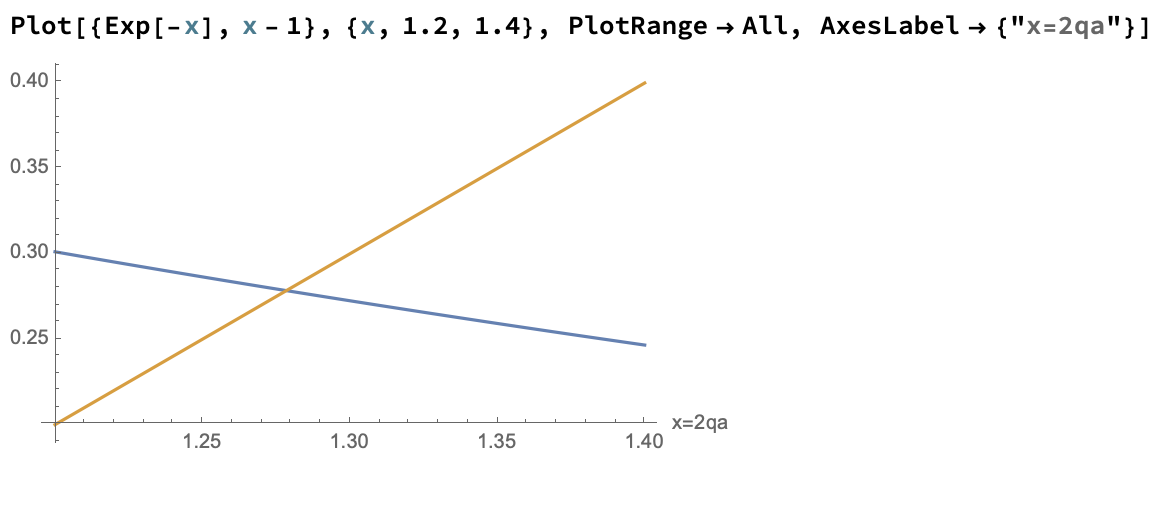
\[E = -\frac{\hbar^2 q^2}{2m} = -\frac{\hbar^2 }{8ma^2}x^2 \] \[-\frac{\hbar^2 }{8ma^2}(1.258)^2 \quad (\mbox{for } c=1)\]
(Bonus!) Also, now I can rewrite my solution in terms of the parameter \(B\):
\begin{align*} \psi_{even} &= \begin{cases} B_{even}\Big(\frac{e^{qa} + e^{-qa}}{e^{-qa}}\Big)e^{qx} & x<-a \quad \mbox{Region 1}\\ B_{even}e^{qx} + B_{even}e^{-qx} & -a<x<a \quad \mbox{Region 2}\\ B_{even}\Big(\frac{e^{qa} + e^{-qa}}{e^{-qa}}\Big)e^{-qx} & a<x \quad \mbox{Region 3} \end{cases} \end{align*}
Recognizing \(e^{qa}+e^{-qa} = \cosh qa\)
\begin{align*} \psi_{even} &= \begin{cases} B_{even}\Big(\frac{\cosh qa}{e^{-qa}}\Big)e^{qx} & x<-a \quad \mbox{Region 1}\\ B_{even}\cosh qx & -a<x<a \quad \mbox{Region 2}\\ B_{even}\Big(\frac{\cosh qa}{e^{-qa}}\Big)e^{-qx} & a<x \quad \mbox{Region 3} \end{cases} \end{align*}
I can normalize the wavefunction to find \(B_{even}\):
\begin{align*} 1 &= \int_{-\infty}^{-a} \Big|B_{even}\Big(\frac{\cosh qa}{e^{-qa}}\Big)e^{qx} \Big|^2 dx + \int_{-a}^{a}\Big|B_{even}\cosh qx \Big|^2 dx + \int_a^{\infty} \Big|B_{even}\Big(\frac{\cosh qa}{e^{-qa}}\Big)e^{-qx} \Big|^2 \\[12pt] &= |B_{even}|^2\Bigg[\Big|\frac{\cosh qa}{e^{-qa}}\Big|^2 \int_{-\infty}^{-a} e^{2qx} dx + \int_{-a}^{a} \cosh ^2 qx \;dx + \Big|\frac{\cosh qa}{e^{-qa}}\Big|^2\int_a^{\infty} e^{-2qx}\Bigg] \\[12pt] &= |B_{even}|^2\Bigg[\frac{\cosh^2 qa}{e^{-2qa}} \frac{1}{2q}e^{2qx}\Bigg|_{-\infty}^{-a} \\[8pt] &\quad + \Big(\frac{1}{4q}\sinh 2qx +\frac{1}{2} \Big)\Big|_{-a}^{a} \\[8pt] &\quad+ \frac{\cosh^2}{e^{-2qa}} \Big(\frac{-1}{2q}\Big)e^{-2qx}\Big|_{a}^{\infty}\Bigg] \\[12pt] &= |B_{even}|^2\Bigg[\frac{\cosh^2 qa}{e^{-2qa}} \frac{1}{2q}\Big(e^{-2qa}-0 \Big)+ \frac{1}{4q}\Big(\sinh 2qa - \sinh(-2qa)\Big) +\frac{1}{2}(a+a) \\ & \quad + \frac{\cosh^2}{e^{-2qa}} \Big(\frac{-1}{2q}\Big)\Big(0-e^{-2qa}\Big) \\[12pt] &= |B_{even}|^2\Bigg[\frac{\cosh^2 qa}{q\cancel{e^{-2qa}}}\cancel{e^{-2qa}} + \frac{1}{2q}\sinh 2qa + a \Bigg] \\[12pt] \rightarrow |B_{even}|^2 &= \frac{1}{\frac{\cosh^2 qa}{q} + \frac{1}{2q}\sinh 2qa + a} \\[12pt] B_{even} &= \sqrt{\frac{2q}{2\cosh^2 qa + \sinh 2qa + 2qa}} \end{align*}
Therefore, the even solution looks like:
\begin{align*} \psi_{even} &= \begin{cases} \sqrt{\frac{2q}{2\cosh^2 qa + \sinh 2qa + 2qa}}\; \Big(\frac{\cosh qa}{e^{-qa}}\Big)e^{qx} & x<-a \quad \mbox{Region 1}\\ \sqrt{\frac{2q}{2\cosh^2 qa + \sinh 2qa + 2qa}}\;\cosh qx & -a<x<a \quad \mbox{Region 2}\\ \sqrt{\frac{2q}{2\cosh^2 qa + \sinh 2qa + 2qa}}\Big(\frac{\cosh qa}{e^{-qa}}\Big)e^{-qx} & a<x \quad \mbox{Region 3} \end{cases} \end{align*}
Simplifying further:
\begin{align*} \psi_{even} &= \begin{cases} \sqrt{\frac{2q \cosh^2 qa}{2\cosh^2 qa + \sinh 2qa + 2qa}}\; e^{q(x+a)} & x<-a \quad \mbox{Region 1}\\ \sqrt{\frac{2q}{2\cosh^2 qa + \sinh 2qa + 2qa}}\;\cosh qx & -a<x<a \quad \mbox{Region 2}\\ \sqrt{\frac{2q\cosh^2}{2\cosh^2 qa + \sinh 2qa + 2qa}} e^{-q(x-a)} & a<x \quad \mbox{Region 3} \end{cases} \end{align*}
Odd Solution:
\begin{align*} B_{odd}e^{qa} - B_{odd}e^{-qa} &= -A_{odd}e^{qa}\\ qA_{odd}e^{-qa} - qB_{odd}e^{qa} - qB_{odd}e^{-qa} &= \frac{-2m\gamma}{\hbar^2}\Big(-A_{odd}e^{-qa}\Big) \end{align*}
From the first equation:
\begin{align*} \rightarrow A_{odd} &= B_{odd}\Big(\frac{e^{-qa}-e^{qa}}{e^{-qa}}\Big) \\ A_{odd} &= -B_{odd}\Big(\frac{\sinh qa}{e^{-qa}}\Big) \end{align*}
Plugging in:
\begin{align*} qB_{odd}\Big(\frac{e^{-qa}-e^{qa}}{\cancel{e^{-qa}}}\Big)\cancel{e^{-qa}} - qB_{odd}e^{q(a)} - qB_{odd}e^{-qa} &= \frac{-2m\gamma}{\hbar^2}\Big(-B_{odd}\Big(\frac{e^{-qa}-e^{qa}}{\cancel{e^{-qa}}}\Big)\cancel{e^{-qa}}\Big) \\[12pt] \cancel{qB_{odd}e^{-qa}}-qB_{odd}e^{qa} - qB_{odd}e^{qa} \cancel{- qB_{odd}e^{-qa}} &= -B_{odd}\frac{-2m\gamma}{\hbar^2}\Big(e^{-qa}-e^{qa}\Big) \\[12pt] \cancel{- 2}q\cancel{B_{odd}}e^{qa} &= -\cancel{B_{odd}}\frac{\cancel{-2}m\gamma}{\hbar^2}\Big(e^{-qa}-e^{qa}\Big) \\[12pt] q\cancelto{1}{e^{qa}} &= -\frac{m\gamma}{\hbar^2}\Big(e^{-\color{blue}{2}qa}-\cancelto{1}{e^{qa}}\Big) \\[12pt] q &= \frac{m\gamma}{\hbar^2} \Big(1-e^{-2qa}\Big) \\[12pt] \end{align*}
Again, this is a transcendental equation.
I'll use a similar approach as before. Rearranging:
\[\frac{\hbar^2 }{m\gamma}\;q+1 = e^{-2qa}\]
Then, I'll let \(x =2qa\) (a dimensionless variable) and choose the strength of the well \(\gamma = \frac{\hbar^2}{2ma}\), so that my equation becomes:
\[ 1-cx = e^{-x}\]
Plotting the right-hand-side and the left-hand-side separately for \(c=1\), I see that they intersect at \(x = 0\). This corresponds to \(E=0\) - there is no bound state! For \(c > 1\) there is no bound state. For \(c<1\), there will be:
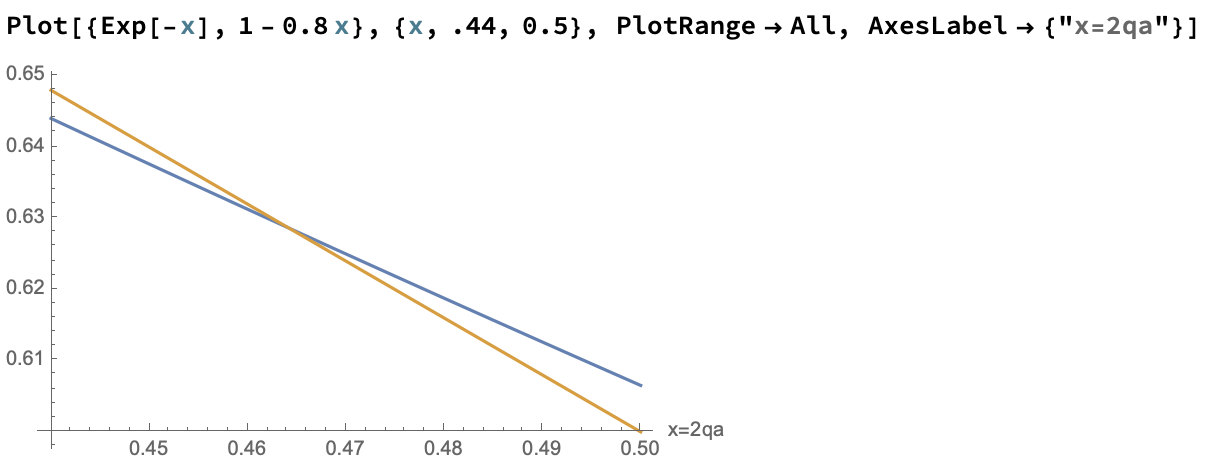
\[E = -\frac{\hbar^2 q^2}{2m} = -\frac{\hbar^2 }{8ma^2}x^2 \] \[-\frac{\hbar^2 }{8ma^2}(1.258)^2 \quad(\mbox{for }c=0.8)\]
I can normalize the wavefunction to find \(B_{odd}\)
The wavefunction is:
\begin{align*} \psi_{odd} &= \begin{cases} -B_{odd}\Big(\frac{\sinh qa}{e^{-qa}}\Big)e^{qx} & x<-a \quad \mbox{Region 1}\\ B_{odd}\sinh qx & -a<x<a \quad \mbox{Region 2}\\ +B_{odd}\Big(\frac{\sinh qa}{e^{-qa}}\Big)e^{-qx} & a<x \quad \mbox{Region 3} \end{cases} \end{align*}
\begin{align*} 1 &= \int_{-\infty}^{-a} \Big|B\Big(\frac{\sinh qa}{e^{-qa}}\Big)e^{qx} \Big|^2 dx + \int_{-a}^{a}\Big|B\sinh qx \Big|^2 dx + \int_a^{\infty} \Big|B\Big(\frac{\sinh qa}{e^{-qa}}\Big)e^{-qx} \Big|^2 \\[12pt] &= |B_{odd}|^2\Bigg[\Big|\frac{\sinh qa}{e^{-qa}}\Big|^2 \int_{-\infty}^{-a} e^{2qx} dx + \int_{-a}^{a} \sinh ^2 qx \;dx + \Big|-\frac{\sinh qa}{e^{-qa}}\Big|^2\int_a^{\infty} e^{-2qx}\Bigg] \\[12pt] &= |B_{odd}|^2\Bigg[\frac{\sinh^2 qa}{e^{-2qa}} \frac{1}{2q}e^{2qx}\Bigg|_{-\infty}^{-a} \\[8pt] &\quad + \Big(\frac{1}{4q}\sinh 2qx +\frac{1}{2} \Big)\Big|_{-a}^{a} \\[8pt] &\quad+ \frac{\sinh^2}{e^{-2qa}} \Big(\frac{-1}{2q}\Big)e^{-2qx}\Big|_{a}^{\infty}\Bigg] \\[12pt] &= |B_{odd}|^2\Bigg[\frac{\sinh^2 qa}{e^{-2qa}} \frac{1}{2q}\Big(e^{-2qa}-0 \Big)+ \frac{1}{4q}\Big(\sinh 2qa - \sinh(-2qa)\Big) +\frac{1}{2}(a+a) \\ & \quad + \frac{\sinh^2}{e^{-2qa}} \Big(\frac{-1}{2q}\Big)\Big(0-e^{-2qa}\Big) \\[12pt] &= |B_{odd}|^2\Bigg[\frac{\sinh^2 qa}{q\cancel{e^{-2qa}}}\cancel{e^{-2qa}} + \frac{1}{2q}\sinh 2qa + a \Bigg] \\[12pt] \rightarrow |B_{odd}|^2 &= \frac{1}{\frac{\sinh^2 qa}{q} + \frac{1}{2q}\sinh 2qa + a} \\[12pt] B_{odd} &= \sqrt{\frac{2q}{2\sinh^2 qa + \sinh 2qa + 2qa}} \end{align*}
Therefore, the odd solution looks like:
\begin{align*} \psi_{odd} &= \begin{cases} -\sqrt{\frac{2q}{2\sinh^2 qa + \sinh 2qa + 2qa}}\; \Big(\frac{\sinh qa}{e^{-qa}}\Big)e^{qx} & x<-a \quad \mbox{Region 1} \\ \sqrt{\frac{2q}{2\sinh^2 qa + \sinh 2qa + 2qa}}\;\sinh qx & -a<x<a \quad \mbox{Region 2} \\ \sqrt{\frac{2q}{2\sinh^2 qa + \sinh 2qa + 2qa}}\Big(\frac{\sinh qa}{e^{-qa}}\Big)e^{-qx} & a<x \quad \mbox{Region 3} \end{cases} \end{align*}
Simplifying further:
\begin{align*} \psi_{odd} &= \begin{cases} -\sqrt{\frac{2q \sinh^2 qa}{2\sinh^2 qa + \sinh 2qa + 2qa}}\; e^{q(x+a)} & x<-a \quad \mbox{Region 1} \\ \sqrt{\frac{2q}{2\sinh^2 qa + \sinh 2qa + 2qa}}\;\sinh qx & -a<x<a \quad \mbox{Region 2} \\ +\sqrt{\frac{2q\sinh^2}{2\sinh^2 qa + \sinh 2qa + 2qa}} e^{-q(x-a)} & a<x \quad \mbox{Region 3} \end{cases} \end{align*}
(extra credit) Sketch the energies as a function of \(x\), you should have two curves. Which state contributes to the formation of the molecule?
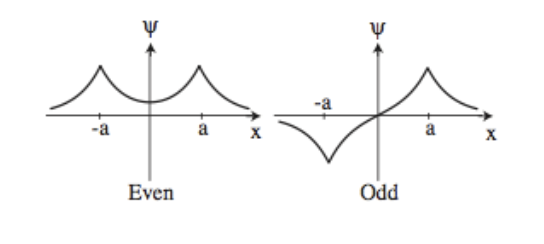
The even state contributes to the formation of the molecule because there is a higher probability density in the region between the nuclei.
- LCAO model for a triatomic molecule
S1 5501S
Consider a linear triatomic molecule in one dimension, modeled within the Linear Combination of Atomic Orbitals (LCAO) approximation. The molecule consists of three identical attractive delta‑function potentials located at positions \(x=-a\), \(x=0\), and \(x=a\): \begin{equation*} V(x)=-\gamma\delta(x+a)-\gamma\delta(x)-\gamma\delta(x-a), \end{equation*} where \(\gamma>0\) is the strength of each potential.
A single attractive delta-function potential, \begin{equation*} V(x)=-\gamma\delta(x), \end{equation*} supports a single bound state with normalized wavefunction \begin{equation*} u(x)=\sqrt{q}e^{-q|x|}, \hspace{1cm} q=\frac{m\gamma}{\hbar^2}, \end{equation*} and corresponding bound-state energy \begin{equation*} \alpha=-\frac{m\gamma^2}{2\hbar^2}. \end{equation*}
Using the functions \(u(x+a)\), \(u(x)\), and \(u(x-a)\) as basis orbitals in an LCAO description of the triatomic system:
Construct the possible molecular eigenfunctions and determine the corresponding energy eigenvalues.
Assume that only nearest‑neighbor overlaps and couplings are significant.
:
LCAO basis
Centered at each delta potential: \begin{eqnarray*} u_1(x)&=&\sqrt{q}e^{-q|x+a|} \\ u_2(x)&=&\sqrt{q}e^{-q|x|} \\ u_3(x)&=&\sqrt{q}e^{-q|x-a|} \end{eqnarray*} The trial wavefunction is \begin{equation*} \psi(x)=c_1u_1(x)+c_2u_2(x)+c_3u_3(x) \end{equation*}
Hamiltonian matrix elements
Because the states are exponentially localized, retain nearest-neigbor couplings only. Then nonvanishing Hamiltonian matrix elements are \begin{eqnarray*} & &\langle 1| \hat{H}|1\rangle=\langle 2| \hat{H}|2\rangle=\langle 3| \hat{H}|3\rangle=\alpha \\ & &\langle 1| \hat{H}|2\rangle=\langle 2| \hat{H}|1\rangle=\langle 2| \hat{H}|3\rangle=\langle 3| \hat{H}|2\rangle=\beta \\ \end{eqnarray*} where \begin{equation} \beta=\alpha(qa+1)e^{-qa}-\gamma u(0)u(a)=(2qa+3)\alpha e^{-qa}<0 \end{equation}
Hamiltonian \begin{equation*} \hat{H}=\begin{pmatrix} \alpha & \beta & 0\\ \beta & \alpha & \beta\\ 0 & \beta & \alpha \end{pmatrix} \end{equation*}
Secular equation
\begin{equation*} \begin{vmatrix} \alpha-E & \beta & 0\\ \beta & \alpha-E & \beta\\ 0 & \beta & \alpha-E \end{vmatrix}=0 \end{equation*} This yields \begin{equation} (\alpha-E)[(\alpha-E)^2-2\beta^2]=0 \end{equation}
Energy eigenvalues \begin{eqnarray*} E_1 &=& \alpha+\sqrt{2}\beta \text{ (bonding)} \\ E_2 &=& \alpha \text{ (nonbonding)} \\ E_3 &=& \alpha-\sqrt{2}\beta \text{ (antibonding)} \\ \end{eqnarray*}
Eigenfunctions
(a) Bonding state \begin{equation*} \psi_1(x) = \frac{1}{2}\left[u_1(x)+\sqrt{2}u_2(x)+u_3(x)\right] \end{equation*} Even parity, lowest energy.
(b) Nonbonding state \begin{equation*} \psi_2(x) = \frac{1}{\sqrt{2}}\left[u_1(x)-u_3(x)\right] \end{equation*} Node at \(x=0\); energy unchanged from single-well value.
(c) Antibonding state \begin{equation*} \psi_3(x) = \frac{1}{2}\left[u_1(x)-\sqrt{2}u_2(x)+u_3(x)\right] \end{equation*}