Contemporary Challenges: Spring-2026
Week 7 HW: Due 21 Friday
- Helium heat capacity
In class, we assumed that all monatomic gases have 3 degrees of freedom (\(f = 3\)). In this question, we explore the possibility that a monatomic gas might have additional degrees of freedom due to the electrons orbiting the nucleus, or the rotation of the nucleus. To answer this question, you will need to use the equipartition theorem and understand how quantized energy levels affect the application of the equipartition theorem.
(a) An atom of helium can store energy by bumping its electron from its lowest orbital energy level to a higher orbital energy level. Moving an electron from the lowest state to the first excited state would store an energy of 24.6 eV (24.6 electron-volts). Give a quantitative explanation (i.e. by comparing quantities) that shows we can ignore this energy storage mode when calculating the heat capacity of helium gas at ordinary temperatures.
(b) The helium-4 nucleus can be modelled as a solid spherical object with mass \(m\), radius \(r\), and moment of inertia \(I=(2/5)mr^2\). If the nucleus starts to rotate, it would have rotational kinetic energy \(K_{\text{rotation}}=L^2/(2I)\), where \(L\) is the angular momentum. Usually the helium-4 nucleus has \(L = 0\), however, it can be excited to a non-zero angular momentum state with \(L \approx \hbar\), or \(2\hbar\), or \(3\hbar\), etc. (\(L\) is quantized). Give a quantitative explanation that shows we can ignore this energy storage mode when calculating the heat capacity of helium gas at ordinary temperatures.
- Flute and boundary conditions
Adapted from Q2M.1 from Chpt 2 of Unit Q, 3rd Edition
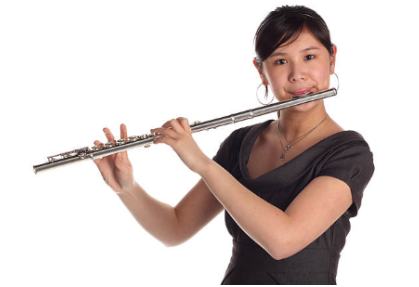
Waves of pressure (sound waves) can travel through air. When there are boundary conditions on a sound wave, the allowed frequencies become discretized (i.e. there is a discrete set of possible values). The same thing happens in quantum mechanics with "matter waves". Before getting fully into quantum mechanics, I want to warm up with musical examples. The PDE for pressure waves in a column of air is \begin{align} \frac{\partial^2p}{\partial t^2}=v_\text{s}^2\frac{\partial^2p}{\partial x^2} \end{align} where \(p\) is the pressure at time \(t\) and position \(x\), and \(v_\text{s}\) is a constant called the the speed of sound in air. We will look for solutions of the form \(p(x,t) = \sin(kx)\cos(wt) + \text{constant}\). The pressure at the open end of a pipe is fixed at 1 atmosphere (this boundary condition is called a node, because pressure doesn't fluctuate). If a pipe has a closed end (which may or may not be true for a flute) the pressure at the closed end can fluctuate up and down (this boundary condition would be called an anti-node).
- A concert flute, shown above, is about 2 ft long. Its lowest pitch is middle C (about 262 Hz). On the basis of this evidence, should we consider a flute to be a pipe that is open at both ends, or at just one end? Support your argument with a quantitative comparison. (The end of the flute farthest from the mouth piece is clearly open. The other end of the flute seems to be closed, so if you claim that the flute is open at both ends, you should try to explain where the other open end is.)
- What are the lowest three frequencies that can be played on a flute when all the finger holes are closed? Give you answer in units of Hz. Draw these frequencies on a spectrogram (vertical axis represents frequency, horizontal axis is time). Multiple horizonal lines at the same time represent the superposition of multiple frequencies.
- Not graded this year - think about this question if you are interested: The orchestra is warming up their instruments. The air in the flute starts at 290 K and increases temperature to 300 K. How seriously does this affect the pitch of the flute? For reference, each step on a chromatic musical scale has a frequency 1.06 times higher than the one below it (1.06 = \(2^{1/12}\)). The conductor of the orchestra will be upset if the flute shifts from its correct frequency by \(\pm 1\%\). The speed of sound in a gas is \(v_s= \sqrt{(\gamma P_0/\rho_0)}\) where \(\gamma\) is a dimensionless constant, \(P_0\) is the ambient pressure and \(\rho_0\) is the gas's density. As the gas warms up, the density of air inside the flute drops (the equilibrium air pressure inside the flute does not change).
- Bugle
In this question, you will analyze a frequency spectrum recorded from a bugle (a demonstration might be done during class). We'll compare the real bugle data to a coarse-grain model, and consider what might be missing from the coarse-grain model.
I found two articles on the internet (links 1 & 2 below) that helped me understand the physics of standing waves in brass instruments.
A didgeridoo is an example of a “closed-open” pipe with a fixed inner diameter. The didgeridoo makes an ethereal/otherworldly sound. Trumpets, trombones and bugles are also “closed-open” pipes, but the inside diameter of the pipe grows bigger at the end of the instrument. To get the “classical” pattern of frequencies, the shape of this flare is critical (trumpets, trombones and bugles all have a similiar flare).
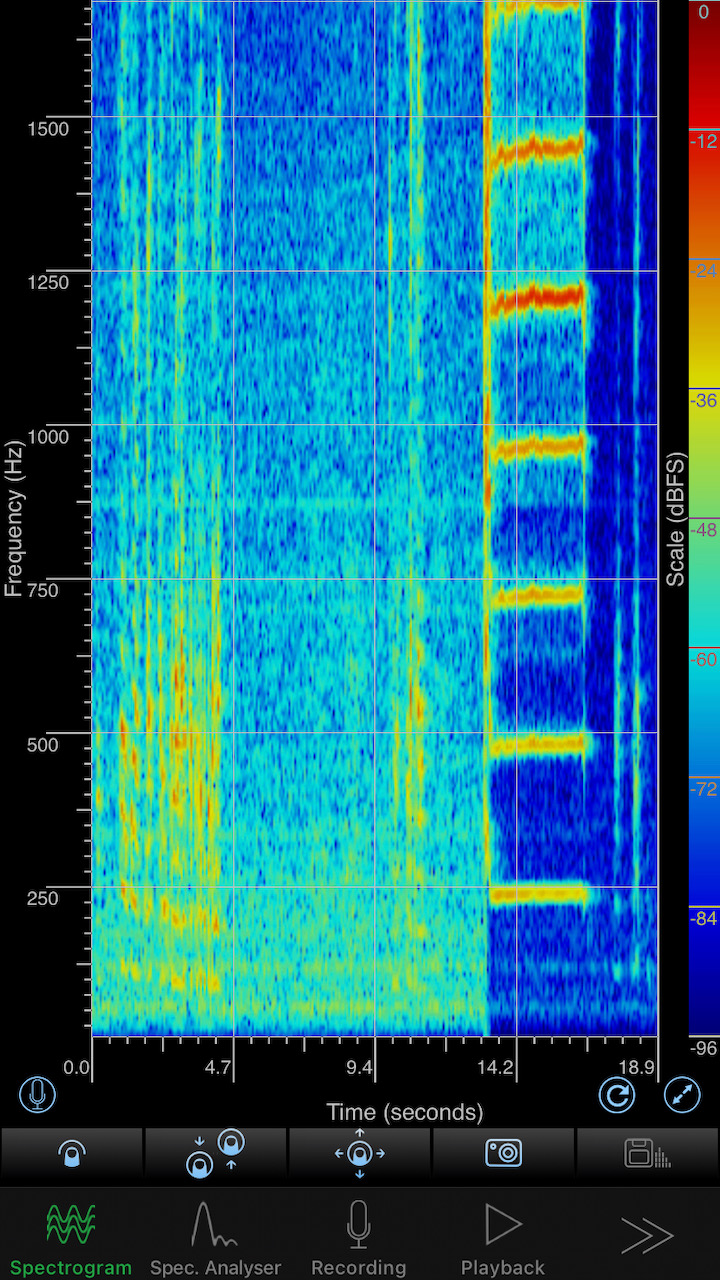
The spectrogram shown below was recorded when I played a note on the bugle. This note is a superposition of the bugle's 2nd resonance (240 Hz), the 4th resonance (480 Hz), the 6th resonance (720 Hz) and so forth. Other resonances were not excited when I played this note. (Other resonances could be excited if I played a different note). I am using a standard convention of numbering the lowest resonant frequency as #1, the next highest resonant frequency as #2, and so forth.
- Draw pressure-vs.-position graphs illustrating four of the allowed standing waves inside a pipe with closed-open boundary conditions. The x-axis represents the distance along the pipe. \(x = 0\) is the mouthpiece (the closed boundary) and \(x = L\) is the open end of the pipe. Draw 4 different graphs. The first graph corresponds to the first resonance. The second graph corresponds to the second resonance and so forth.
- Using your four graphs, find expressions for the wavelength and frequency of each standing wave. I'm looking for symbollic expressions in terms of \(L\) and the \(v_s\). Make sure that you can deduce the wavelength from your graphs, rather than resorting to a textbook formula.
- The fourth resonance of the actual bugle is 480 Hz. Find the length of straight pipe for which the coarse-grained model matches this experimental result. Use this estimated length to determine if the coarse-grained model correctly predicts resonant frequency #2 (numerical answer).
- Present your analysis by drawing side-by-side spectrograms. On the first spectrogram, show the resonant frequencies #2 and #4 predicted by the coarse grain model. On the second spectrogram, show the resonant frequencies #2 and #4 measured from the bugle. Speculate on what might cause the descrepancy between the model and the real world.
Some helpful figures from the internet articles:
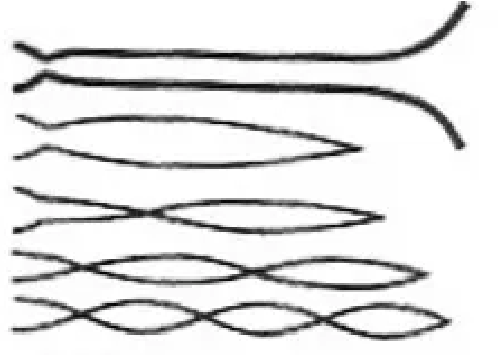
Figure 1: Approximate pressure distribution for the first four modes in a trumpet. Note that the “turning point” moves outward in the bell as the frequency increases. Mode frequencies are nearly in the ratios 0.8 : 2 : 3 : 4. 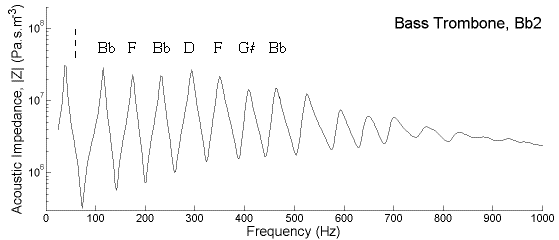
Figure 2: The resonant modes of a brass instrument can be determined by finding the peaks in the acoustic impendance.